• Company
    • About Us
    • Case Studies
    • Press Center
    • Careers
    • Blog
    • Contact us
  • Contact us
  • Login
 
  • English
    • Deutsch
    • Español
    • Français
    • Italiano
    • Português
Paessler
                    - The Monitoring Experts
  • Products
    • Paessler PRTG
      Paessler PRTGMonitor your whole IT infrastructure
      • PRTG Network Monitor
      • PRTG Enterprise Monitor
      • PRTG Hosted Monitor
      • PRTG UVexplorer
      • PRTG extensionsExtensions for Paessler PRTGExtend your monitoring to a new level
    • Icon Features
      FeaturesExplore all monitoring features
      • Maps & dashboards
      • Alerts & notifications
      • Multiple user interfaces
      • Distributed monitoring
      • Customizable reporting
  • Solutions
    • Industries
      IndustriesMonitor various industry sectors
      • Industrial
      • Healthcare
      • Data Center
      • Education
      • Finance
      • Government
    • IT Topics
      IT TopicsMonitor all areas of IT
      • Network Monitoring
      • Bandwidth Monitoring
      • SNMP Monitor
      • Network Mapping
      • WiFi Monitoring
      • Server Monitoring
  • Pricing
  • Resources
    • Getting Started
      Getting StartedModules for self-paced learning
    • How-to Guides
      How-to GuidesGet the most out of PRTG
    • Videos & Webinars
      Videos & WebinarsLearn from Paessler experts
    • IT  Knowledge
      IT KnowledgeExpand your IT knowledge
    • PRTG Manual
      PRTG ManualFull documentation
    • Knowledge Base
      Knowledge BaseShare community knowledge
    • PRTG Sensor Hub
      PRTG Sensor HubGet sensors, scripts & templates
    • Trainings
      PRTG TrainingLearn how to work with PRTG
  • Partners
    • Icon Handshake
      Become a PartnerFor resellers and channel partners
    • Icon MSP
      Become an MSPDeliver monitoring as a managed service
    • icon partner
      Partner PortalLog in to your partner account
    • Deal Registration
      Deal RegistrationRegister your sales opportunities
    • icon search
      Find a PartnerFind partners selling Paessler products
    • icon technology
      Technology AlliancesSee Paessler technology partnerships
    • Partner HubTools for Your Success
  • Company
    • About Us
    • Case Studies
    • Press Center
    • Careers
    • Blog
    • Contact us
  • Contact us
  • Login
  • English
    • Deutsch
    • Español
    • Français
    • Italiano
    • Português
  • Get a quote
  • Free trial

Powerful LAN Scanner  

Find every device on your network. Know when something goes wrong before your users do.  

Free download
PRODUCT OVERVIEW

What Is the Difference Between a LAN Scanner and Continuous LAN Monitoring? 

A LAN scan returns a list of what was reachable at that moment: IP addresses, MAC addresses, device types. Five minutes later, something could drop off the network and the list would not reflect it. Continuous LAN monitoring picks up where a scan stops, polling devices on defined intervals and storing everything it collects. 

Paessler PRTG handles both: it discovers devices via auto-discovery and keeps monitoring them afterward using ICMP, SNMP, flow protocols (NetFlow/IPFIX/sFlow/jFlow), and TCP service checks. No manual re-runs required. The data keeps coming in across the usual mix of routers, switches, servers, printers, workstations, access points, and IoT gear, across both IPv4 and IPv6.  

What PRTG uses to scan and monitor your LAN: ICMP · ARP · SNMP · NetFlow v5/v9 · IPFIX · sFlow v5 · jFlow v5 · TCP port checks · DNS  

Download PRTG Trial

What you will find on this page

  • From Discovery to Visibility
  • How PRTG Scans Your LAN
  • Where Free Tools Stop and PRTG Starts
  • FAQs

PRTG is compatible with all major vendors, products, and systems

compatible with all major vendors, products, and systems

From Device Discovery to Full LAN Visibility

See Every Device on Your Network Without Touching a Spreadsheet  

You define the IP range. PRTG does the rest.  

Auto-discovery scans the subnet, identifies devices, and builds a structured device tree with sensors pre-assigned. No manual IP-by-IP work, no spreadsheet to maintain, no CSV to update every time something changes.  

  • Scans any defined IP range or subnet on demand or on a schedule
  • Builds a complete device tree of all reachable network devices
  • Identifies device types automatically and pre-assigns sensor templates
  • Works across routers, switches, servers, printers, workstations, and more
  • Covers IPv4 networks; IPv6 devices reachable via ICMP ping

A Scan Tells You What's There. PRTG Tells You What's Happening.  

Advanced IP Scanner and nmap do one thing well: they produce a snapshot. The moment the scan finishes, the data starts going stale. Nothing is retained. Nothing runs tomorrow unless you run it again.  

PRTG stores everything it collects. Historical records are kept per sensor, so you can track performance over time, spot trends before they become problems, and run reports without manually assembling data from separate scan results. 
  • Retains historical monitoring data for reporting and capacity planning
  • Sends notifications via email, SMS, or push when thresholds are exceeded
  • Persistent device records that update automatically, not a one-time snapshot
  • 250+ native sensor types covering availability, traffic, hardware, and services
  • Exportable reports and dashboards, not just raw scan results
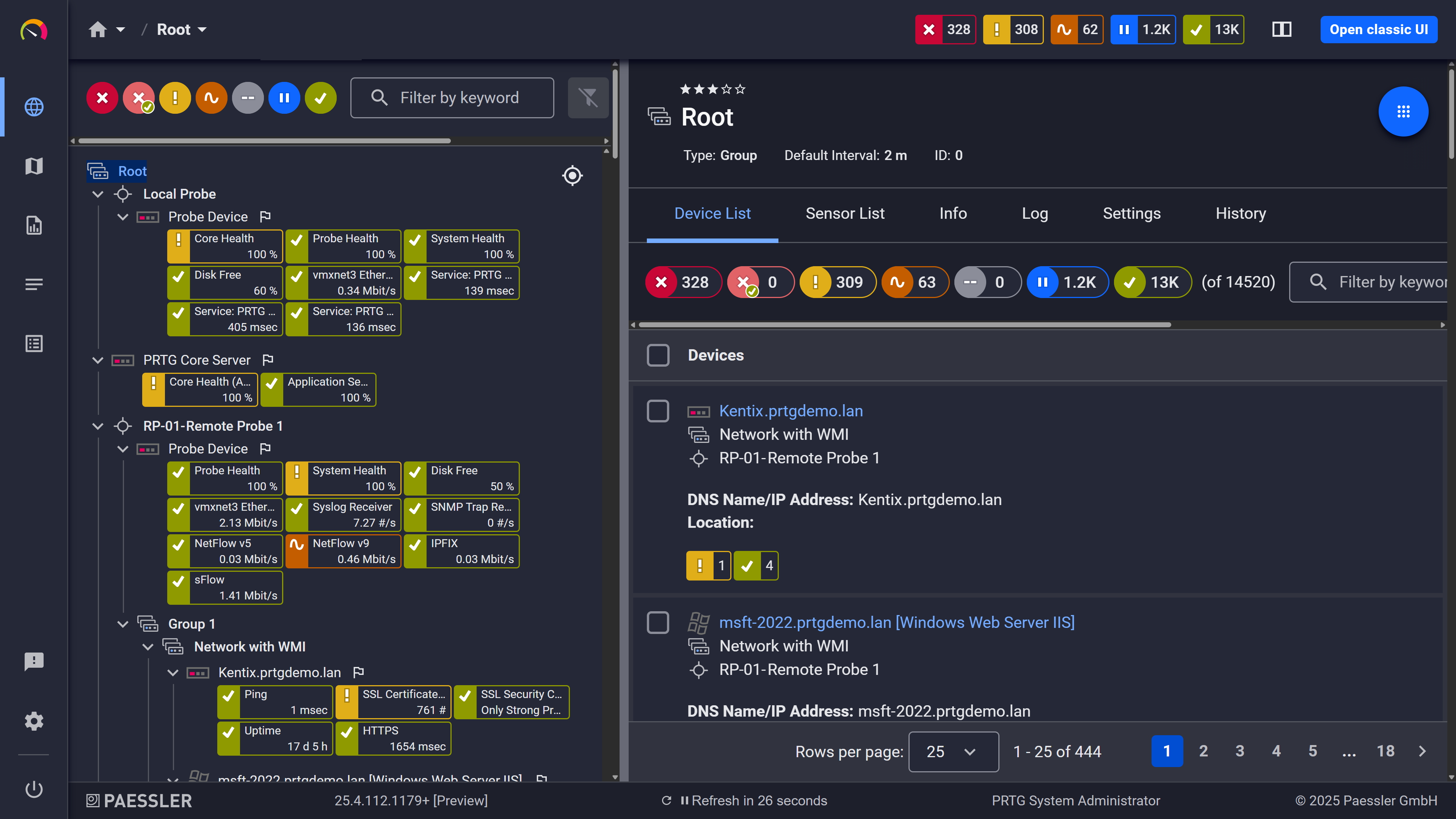
PRTG web interface showing device tree and full device list with sensor status badges

Full device list, instant overview

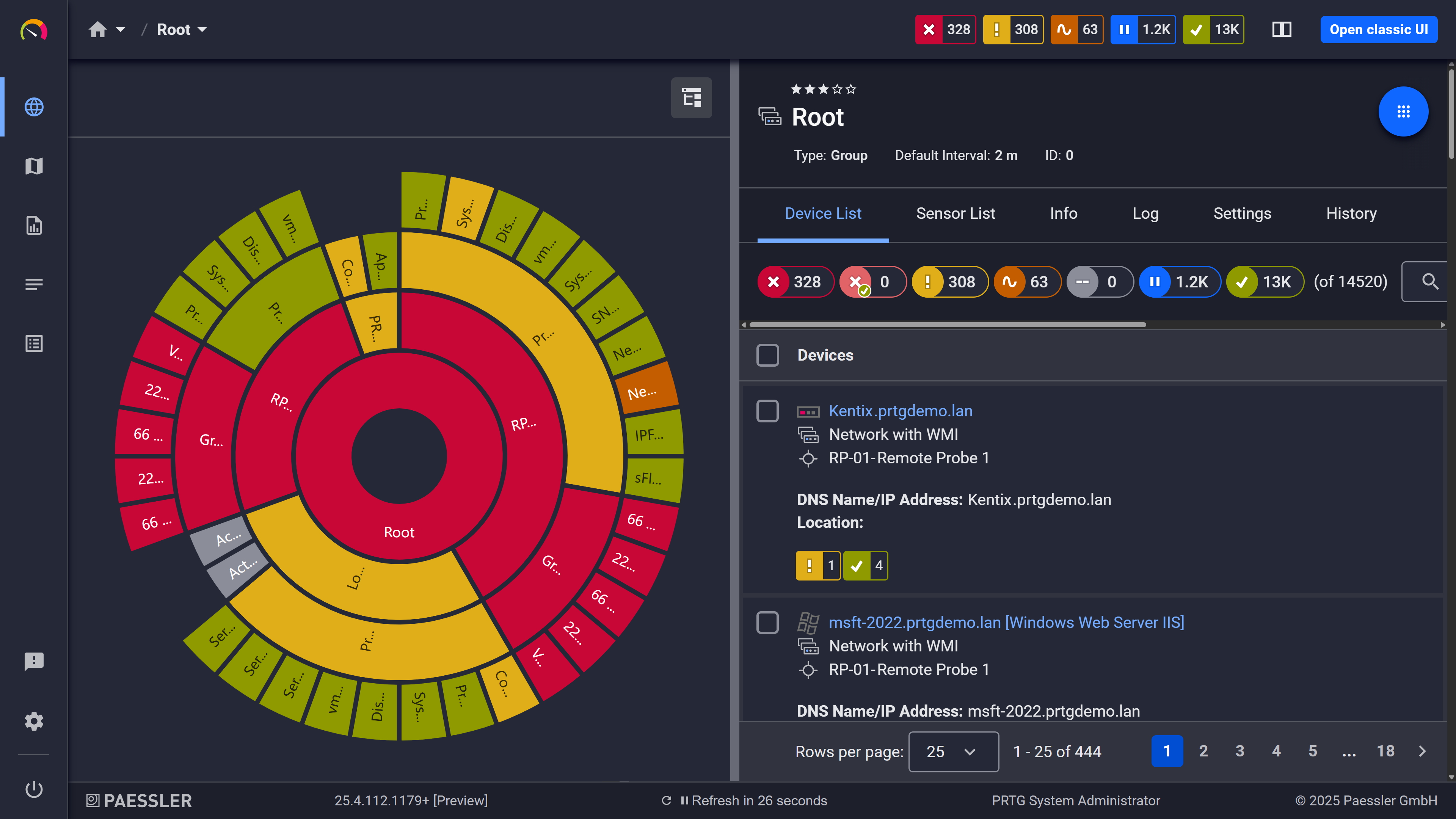
PRTG sunburst chart visualizing the full network hierarchy with color-coded sensor status

Your entire network, visualized instantly
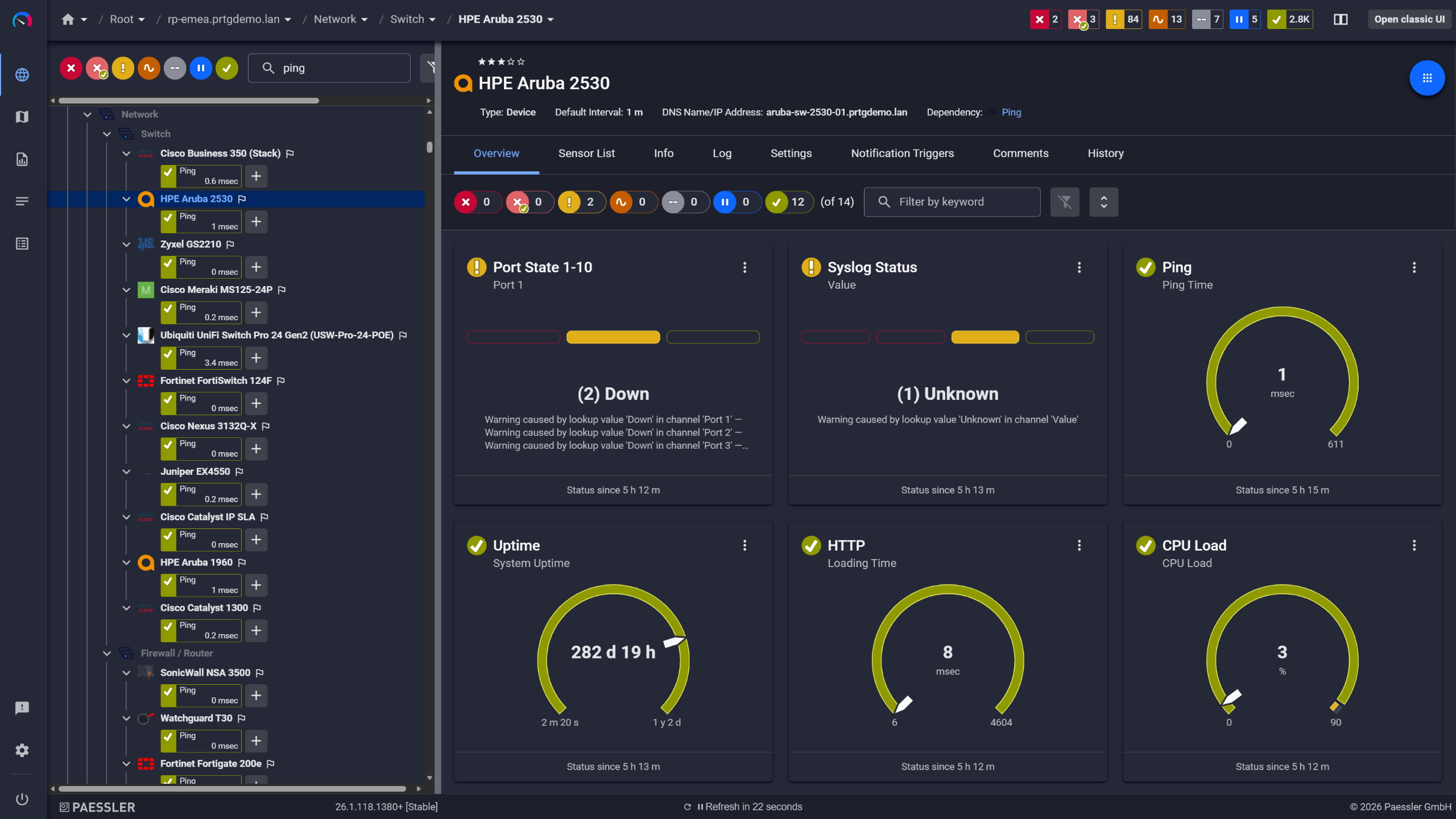
PRTG device overview for an HPE Aruba 2530 switch with port state, ping, and CPU sensors

Network switches monitored across vendors

Configure It Once. It Runs Whether You're There or Not.  

PRTG runs as a permanent background service and performs scheduled discovery and monitoring tasks automatically. Scheduled re-discovery (hourly, daily, or weekly) checks for newly connected devices and logs them automatically. When a known device stops responding, PRTG sends an alert. 

  • Runs as a permanent Windows background service with no manual launch required
  • Scheduled re-discovery at hourly, daily, or weekly intervals
  • Logs newly discovered devices automatically; your inventory stays current without manual review
  • Sends an alert when known devices go offline or become unreachable
  • Configurable scanning intervals per subnet or network segment

See Why IT Professionals Trust PRTG

Start monitoring your infrastructure in minutes. No professional services, no complex configuration, no risk.

Free download
PRODUCT OVERVIEW

Know What Your Devices Are Actually Doing 

Availability checks confirm a device is reachable. Performance monitoring tells you what it is actually doing. PRTG collects both after discovery, giving you bandwidth consumption, interface errors, service availability, and load data continuously. You can see what is happening on the network, not just confirm that devices are present. 
  • Per-interface bandwidth monitoring across your LAN
  • Traffic breakdown by protocol type, so you can identify what's consuming capacity
  • Hardware metrics across discovered devices: CPU load, memory usage, and disk
  • Service-level checks on TCP ports for every discovered device, verifying that services are active and accepting connections
  • Real-time data with configurable alert thresholds per metric
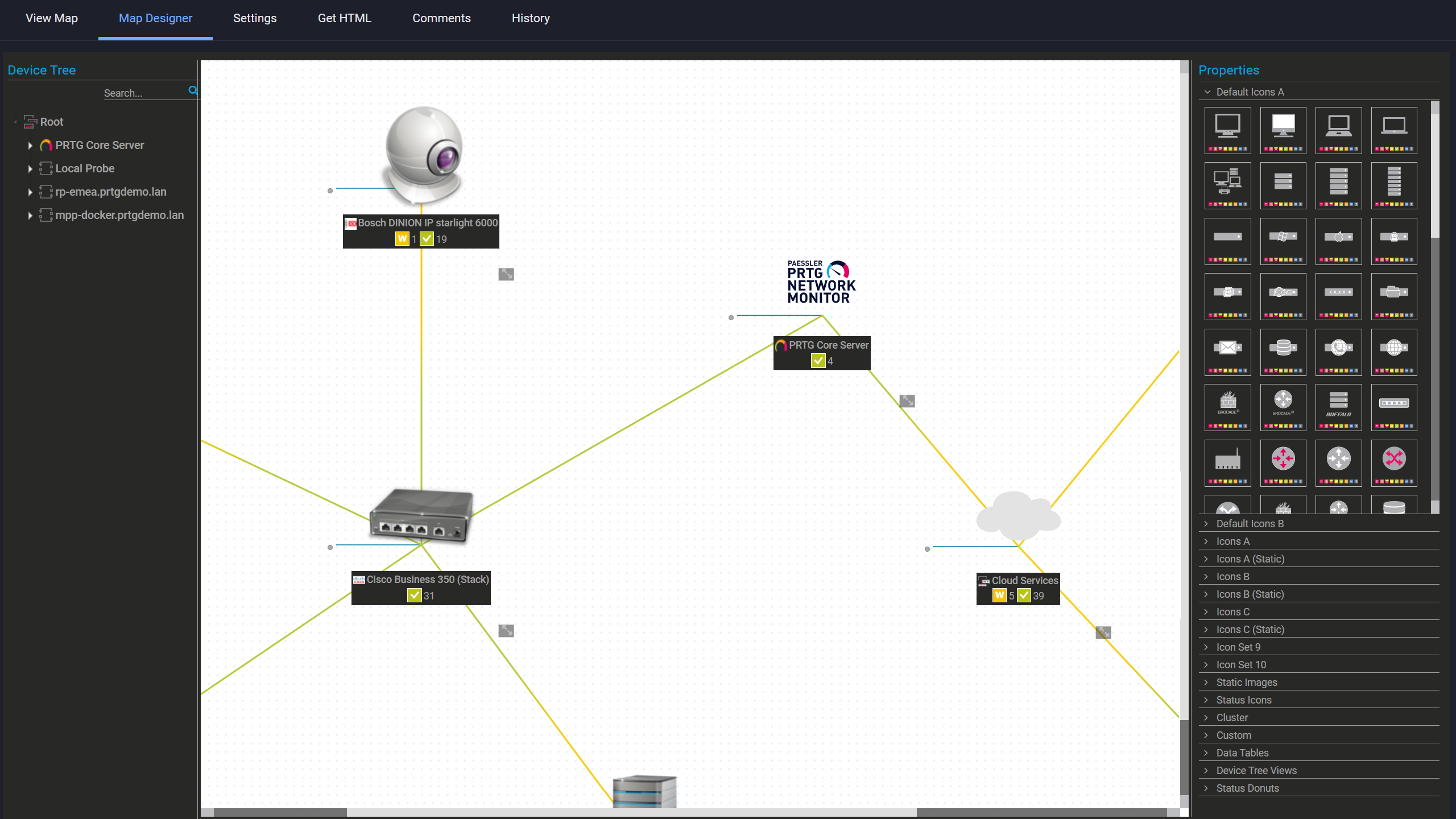
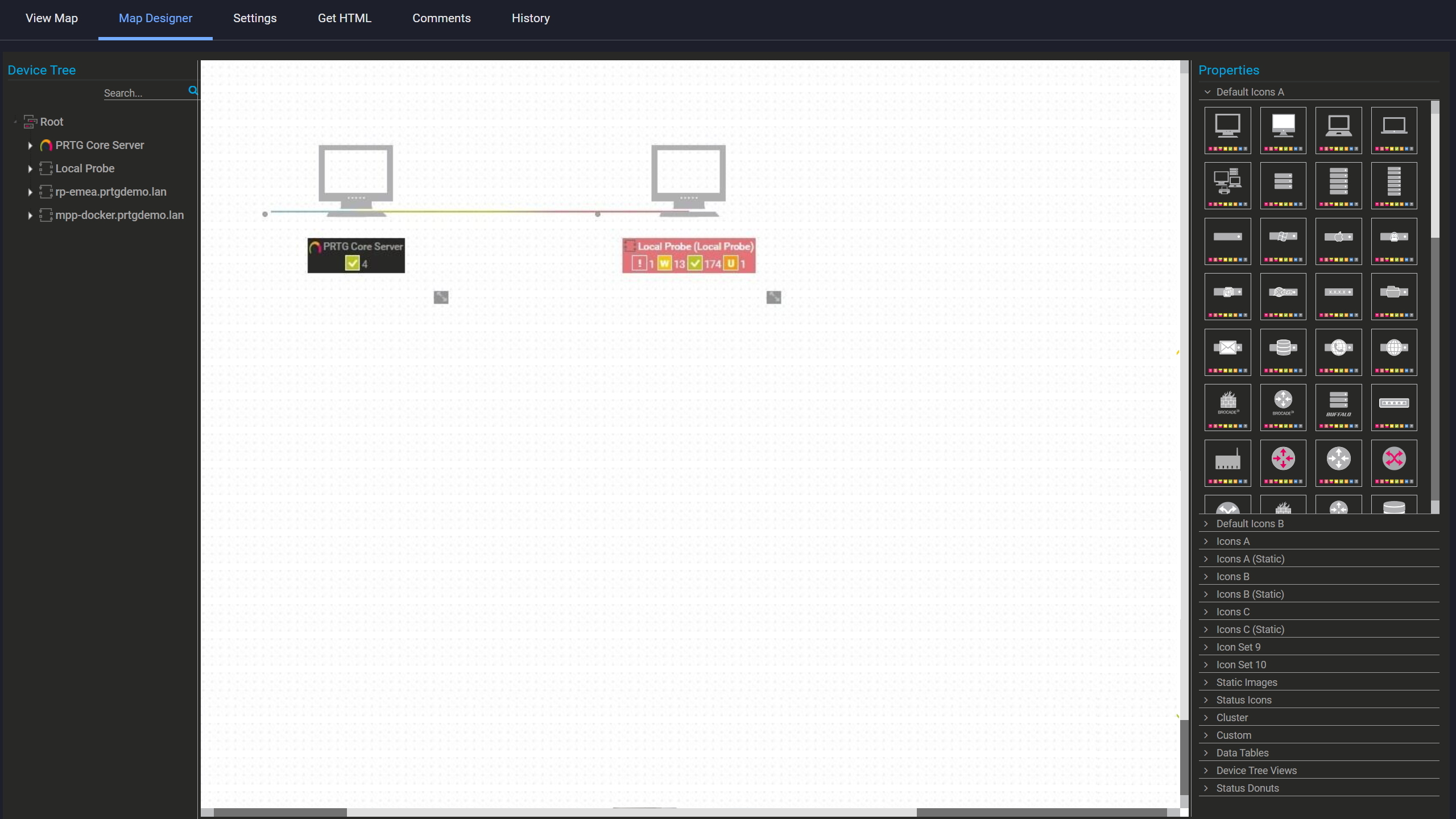
PRTG Map Designer with two network devices placed on a blank canvas

Build your own network map

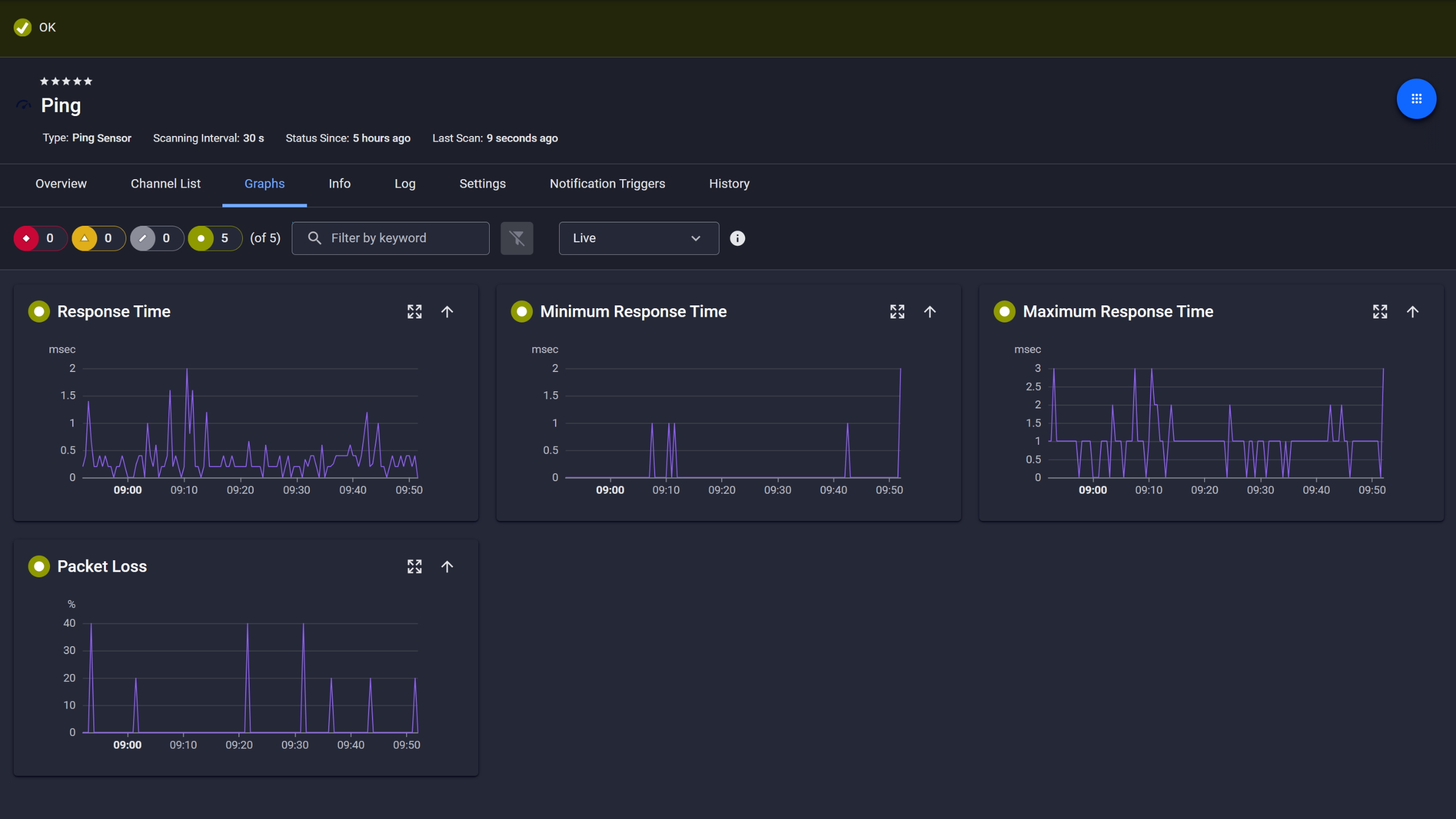
PRTG Ping sensor graphs showing response time, min, max, and packet loss over time

Ping response and packet loss

PRTG Map Designer showing a custom network map with live device status and vendor icons

Custom maps with live status

Independent LAN Monitoring for Sites That Manage Their Own Network 

If your site manages its own network separately from a central IT department, you need monitoring that fits your setup, not one that depends on infrastructure you don't control.  

Install a PRTG probe at your location, run discovery locally, and get full LAN visibility feeding into one central dashboard. No VPN dependency. No waiting on anyone. 

  • Remote probes install at any site and scan the local LAN independently
  • Classic remote probes run on Windows; multi-platform probes extend coverage to Linux systems
  • Operates across firewalls without requiring inbound connections to the core server
  • Each site gets its own auto-discovery and device tree
  • All site data centralized in one PRTG interface for a unified view

How PRTG Scans and Monitors Your Local Network   

PRTG doesn't use one method to collect data. It uses several. What each one returns is different, and so are the gaps.  

SNMP Monitoring

PRTG polls SNMP-capable devices using SNMPv1, v2c, or v3. What comes back is interface-level data: traffic in and out, error rates, hardware status. For managed switches, routers, and servers, this is the primary monitoring method once discovery has run.  

Devices without SNMP support aren't ignored. PRTG can still ping them for availability. They just won't return interface or hardware data.  

Flow Data Analysis 

SNMP tells you how much traffic is moving. Flow data tells you what it's made of.  

PRTG receives flow exports from compatible routers and switches. The NetFlow v5 Sensor, NetFlow v9 Sensor, IPFIX Sensor, sFlow Sensor, and jFlow v5 Sensor each handle their respective format. What you get is a breakdown by protocol, application type, or connection pair. 

Packet Sniffing

No flow-capable hardware on a segment? The Packet Sniffer sensor reads headers of packets passing through a local network adapter and sorts traffic by protocol channel. That's it. Payload content is out of scope, it's not a deep packet inspection tool. You get protocol distribution and traffic patterns, nothing about what's inside. 

TCP Port Checks 

Discovery tells you a device is there. The Port v2 Sensor tells you whether its services are actually running.  

It connects to TCP/IP ports on any discovered device and checks whether the service is accepting connections. HTTP, HTTPS, FTP, SSH, any custom port you define. It works at the TCP level, so any TCP-based service is covered.  

RDP is handled separately. PRTG has a dedicated RDP (Remote Desktop) Sensor for that. UDP-based services like DNS or RADIUS have their own protocol sensors too.  

One thing the Port v2 Sensor doesn't measure: throughput. It tells you whether the port is reachable, not how much data is moving through it. 

DNS Resolution

PRTG resolves hostnames for discovered devices, so your device tree shows readable names instead of raw IP addresses. In larger LANs, that matters more than it sounds. When you're working through 200 devices trying to track down the one that just dropped off, navigating by IP alone costs you time. And if you're not keeping a separate inventory that maps addresses to names somewhere, you're working without a map. DNS resolution means your tree reflects how you actually think about your network. 

free downLoad

LAN Scanner vs. LAN Monitor: Where Free Tools Stop and PRTG Starts 

capability

Free scanners

Free scanners

PRTG

PRTG

Device discovery 

Free scanners
not included

On demand, manual, one-time. 

PRTG
included

Automated, scheduled, continuous. 

Continuous monitoring 

Free scanners
not included

No. Scan ends, monitoring ends. 

PRTG
included

Yes. Runs as a permanent background service. 

Historical data and trends 

Free scanners
not included

No. Each scan is a fresh start. 

PRTG
included

Stored per sensor. Trends and reports included. 

Threshold alerting 

Free scanners
not included

No. You find out when users complain. 

PRTG
included

Email, SMS, and push when thresholds are exceeded. 

Traffic analysis (NetFlow, SNMP) 

Free scanners
not included

No. Devices only, no traffic data. 

PRTG
included

SNMP, NetFlow, and packet sniffing per interface. 

Remote and multi-site LAN coverage 

Free scanners
not included

No. One subnet, one tool, manually. 

PRTG
included

Remote probes per site, all feeding one dashboard. 

free downLoad

“I would recommend PRTG because it has helped us significantly improve service uptime by highlighting important alerts that would otherwise result in a system failure or service disruption if action was not taken. Thanks to PRTG, we can ensure that The Ritz London’s network and IT systems are five-star, just like the hotel.”

Richard Isted, IT Manager
The Ritz London

Ultimately, people do better when they focus on the solution, not the tool. This is the mantra we live by at Skyscanner. Without PRTG, we’d still be spending half a day or more on monitoring our internal tools.

Barry Kelly, Systems Engineer
Skyscanner

Adopting PRTG has been like going from being in the dark to being in the light. Before, we had limited visibility into what was happening in the infrastructure and in the network. Now, however, thanks to the comprehensive dashboard and real-time notifications, we receive constant updates on the status of facilities and services, and our way of working has gone from passive to proactive.

Luca Meneghesso, senior IT infrastructure and security specialist
Banca Profilo

Paessler PRTG Network Monitor licenses & pricing

Choose the PRTG Network Monitor subscription that's best for you.

License NameLicense descriptionPriceLicense DetailsGet startedPricing Details
PRTG 500$200per month paid annuallyBuy nowBuy now

Enough to monitor multiple aspects of 50 devices

PRTG 1000$358per month paid annuallyBuy nowBuy now

Enough to monitor multiple aspects of 100 devices

PRTG 2500$742per month paid annuallyBuy nowBuy now

Enough to monitor multiple aspects of 250 devices

PRTG 5000$1,300per month paid annuallyBuy nowBuy now

Enough to monitor multiple aspects of 500 devices

PRTG 10000$1,642per month paid annuallyBuy nowBuy now

Enough to monitor multiple aspects of 1000 devices

Over 100,000 Customers Worldwide Love Paessler  

customer success stories

 [H2] XXX: Frequently Asked Questions


Does PRTG support IPv6 network scanning?

Partly. PRTG discovers IPv6 devices via ICMP ping, so availability monitoring works fine. ARP-based MAC address identification is IPv4 only, and that's what drives device type icons and automatic template matching. IPv6-only hosts show up in discovery. They just won't get auto-classified the same way. 

Can I limit the scan to a specific subnet or IP range?

That's how auto-discovery works in PRTG. You define the IP range or subnet, and it scans exactly that. Nothing outside what you specify. If you're managing multiple segments, separate discovery tasks can run for different ranges at the same time. 

Is PRTG a replacement for nmap or Advanced IP Scanner?

Different tools built for different things. nmap and Advanced IP Scanner give you a snapshot: run them, get a result, done. The moment the scan finishes, the data starts going stale. PRTG discovers devices and then keeps monitoring them. For security-focused port scanning specifically, nmap is still the better choice for that job. 

Can PRTG run network scans from the command line?

PRTG is primarily operated via its web UI and mobile apps. For automation and integration, use the REST API rather than a dedicated interactive CLI workflow. For scripted or automated interaction, there's a REST API, but if your workflow specifically needs CLI-based scanning, nmap handles that better. 

Does PRTG work as a free network scanner?

There's a free trial with full functionality, auto-discovery and LAN scanning included. After that, a license is required. Worth knowing that PRTG isn't a standalone scanner in the traditional sense. Device discovery is one part of what it does. The rest is continuous monitoring, alerting, and reporting, and free scanning tools don't cover any of that. 

Paessler PRTG

Paessler PRTG

Network Monitoring Software – Version 26.1.116.1532 (February 9th, 2026)

Hosting icon

Hosting

Download for Windows and cloud-based version PRTG Hosted Monitor available

Languages icon

Languages

English, German, Spanish, French, Portuguese, Dutch, Russian, Japanese, and Simplified Chinese

test

Monitor everything

Network devices, bandwidth, servers, applications, virtual environments, remote systems, IoT, and more

test

Pricing

Choose the PRTG Network Monitor subscription that's best for you

Discover more monitoring insights and stories

Content illustration

Powerful stories from the monitoring world

  • How to see all IP addresses on network: A guide for IT professionals
  • How to identify unknown devices on your network: A complete guide
  • How to find IP addresses on your network: A complete guide for IT ...
Support illustration

Resources to master your monitoring challenges

  • dose PRTG try to scan all the device's port 3389 in the network by ...
  • Local probe disconnected, how can i fix it
  • How can I monitor a Cisco WLC deployment with PRTG?
Solution illustration

Solutions for all your monitoring needs

  • LAN Scanner
  • Local Network Scanner
  • Free Network Scanner
PRTG Logo

Start Monitoring with PRTG and see how it can make your network more reliable and your job easier.

Free download
PRODUCT OVERVIEW

Products

  • Paessler PRTG
    Paessler PRTGMonitor your whole IT infrastructure
    • PRTG Network Monitor
    • PRTG Enterprise Monitor
    • PRTG Hosted Monitor
    • PRTG UVexplorer
    • PRTG extensions
      Extensions for Paessler PRTGExtend your monitoring to a new level
  • Icon Features
    FeaturesExplore all monitoring features

Monitoring with PRTG

  • Network monitoring
  • Bandwidth monitoring
  • SNMP monitoring
  • Network mapping
  • Wi-Fi monitoring
  • Server monitoring
  • Network traffic analyzer
  • NetFlow monitoring
  • Syslog server

Useful Links

  • PRTG Manual
  • Knowledge Base
  • Customer Success Stories
  • About Paessler
  • Subscribe to newsletter
  • PRTG Support
  • PRTG Consulting
  • PRTG Feedback & Roadmap

Contact

Paessler GmbH
Thurn-und-Taxis-Str. 14, 
90411 Nuremberg 
Germany

[email protected]

+49 911 93775-0

  • Contact us
©2026 Paessler GmbHTerms & ConditionsPrivacy PolicyImprintReport VulnerabilityDownload & InstallSitemap
Manual License Activation Manual License Activation Manual License Activation