




• Company
    • About Us
    • Case Studies
    • Press Center
    • Careers
    • Blog
    • Contact us
  • Contact us
  • Login
 
  • English
    • Deutsch
    • Español
    • Français
    • Italiano
    • Português
Paessler
                    - The Monitoring Experts
  • Products
    • Paessler PRTG
      Paessler PRTGMonitor your whole IT infrastructure
      • PRTG Network Monitor
      • PRTG Enterprise Monitor
      • PRTG Hosted Monitor
      • PRTG UVexplorer
      • PRTG extensionsExtensions for Paessler PRTGExtend your monitoring to a new level
    • Icon Features
      FeaturesExplore all monitoring features
      • Maps & dashboards
      • Alerts & notifications
      • Multiple user interfaces
      • Distributed monitoring
      • Customizable reporting
  • Solutions
    • Industries
      IndustriesMonitor various industry sectors
      • Industrial
      • Healthcare
      • Data Center
      • Education
      • Finance
      • Government
    • IT Topics
      IT TopicsMonitor all areas of IT
      • Network Monitoring
      • Bandwidth Monitoring
      • SNMP Monitor
      • Network Mapping
      • WiFi Monitoring
      • Server Monitoring
  • Pricing
  • Resources
    • Getting Started
      Getting StartedModules for self-paced learning
    • How-to Guides
      How-to GuidesGet the most out of PRTG
    • Videos & Webinars
      Videos & WebinarsLearn from Paessler experts
    • IT  Knowledge
      IT KnowledgeExpand your IT knowledge
    • PRTG Manual
      PRTG ManualFull documentation
    • Knowledge Base
      Knowledge BaseShare community knowledge
    • PRTG Sensor Hub
      PRTG Sensor HubGet sensors, scripts & templates
    • Trainings
      PRTG TrainingLearn how to work with PRTG
  • Partners
    • Icon Handshake
      Become a PartnerFor resellers and channel partners
    • Icon MSP
      Become an MSPDeliver monitoring as a managed service
    • icon partner
      Partner PortalLog in to your partner account
    • Deal Registration
      Deal RegistrationRegister your sales opportunities
    • icon search
      Find a PartnerFind partners selling Paessler products
    • icon technology
      Technology AlliancesSee Paessler technology partnerships
    • Partner HubTools for Your Success
  • Company
    • About Us
    • Case Studies
    • Press Center
    • Careers
    • Blog
    • Contact us
  • Contact us
  • Login
  • English
    • Deutsch
    • Español
    • Français
    • Italiano
    • Português
  • Get a quote
  • Free trial
  1. Home>
  2. IT Topics>
  3. Performance>
  4. Jitter Monitoring

Enhance Network Performance with Jitter Monitoring Solutions from PRTG

Get rid of delays and speed up performance

  • Run network jitter tests to detect issues quickly
  • Keep an eye on VoIP and QoS for optimal performance
  • Get jitter alerts for faster, proactive troubleshooting
Free download
PRODUCT OVERVIEW

Our Users Give Top Ratings for Monitoring With Paessler PRTG

Gartner peer insights
spiceworks
G2
Capterra

PRTG jitter monitoring: What you will find on this page

Table of content

    PRTG makes network jitter monitoring as easy as it gets

    Custom alerts and data visualization let you quickly identify and prevent network latency and other network performance issues.

    Free download
    PRODUCT OVERVIEW

    Advantages of using PRTG to measure jitter for VoIP

    Many companies use VoIP (Voice over Internet Protocol). However, one single delayed data packet can lead to transmission errors and disruptions that are noticeable at once: Jitter can cause the call quality or video quality to go down or fill the line with static. With Paessler PRTG jitter monitoring, you’ll keep a constant eye on jitter values to make sure this doesn’t happen.

    icon watch

    Stable video calls

    In companies that use VoIP, employees can’t work efficiently unless the network is stable. Make sure your coworkers are able to do their jobs without interruption with PRTG jitter monitoring.

    If fluctuations in jitter values occur, you can quickly intervene to eliminate them. Our network monitoring tool also enables you to monitor other parameters that affect your network’s quality of service (QoS).

    icon alarm

    Custom real-time alerts

    PRTG stands out from other latency and jitter monitoring tools – its alerting system is completely customizable. It immediately notifies you in the event of a problem via SMS, email, push notification, and more, so you can react quickly and before noticeable outages occur.

    Thanks to PRTG, you’ll lift a huge weight off the shoulders of your support team, as fewer coworkers will have incidents to report.

    What jitter monitoring looks like in PRTG

    Diagnose network issues by continuously tracking jitter levels in your network. Show statistical jitter, MOS, round-trip time (RTT), and other key metrics in real time. Visualize jitter monitoring data in clear graphs and dashboards to identify problems more easily. Gain the overview you need to troubleshoot network congestion and jitter issues.
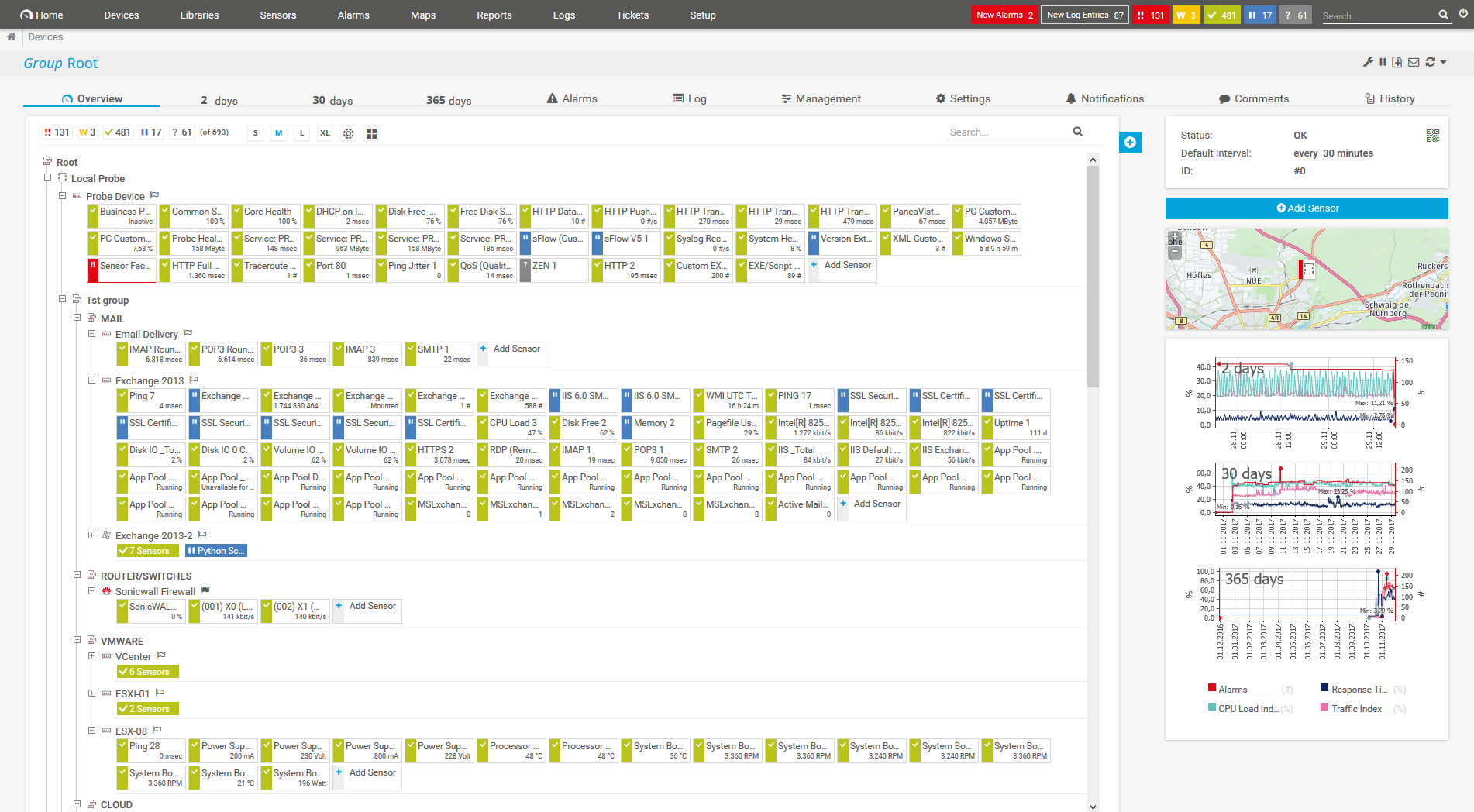
    PRTG Screenshot device tree view

    Device tree view of the complete monitoring setup
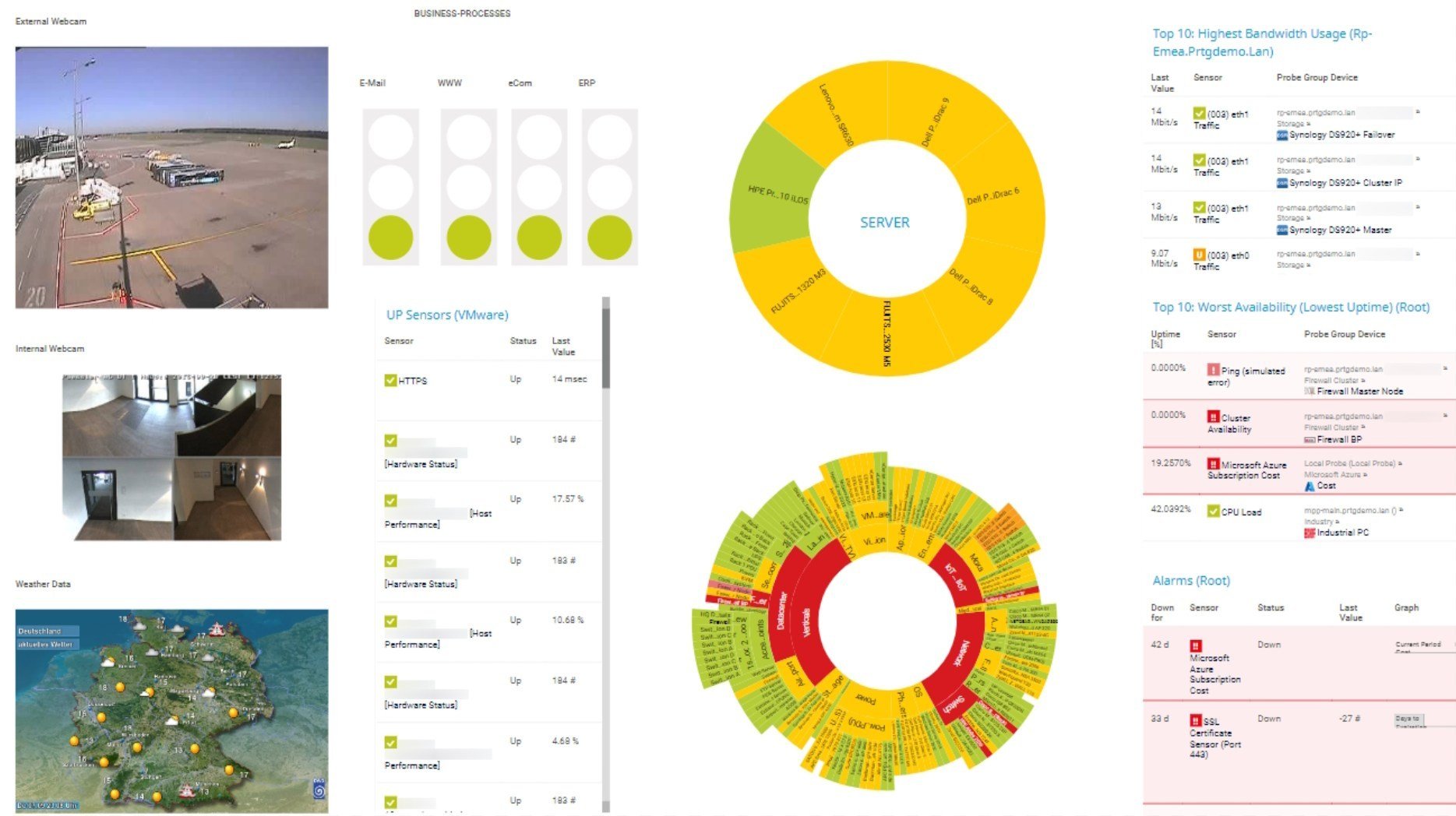
    PRTG screenshot map entire it infrastructure

    Custom PRTG dashboard for keeping an eye on the entire IT infrastructure
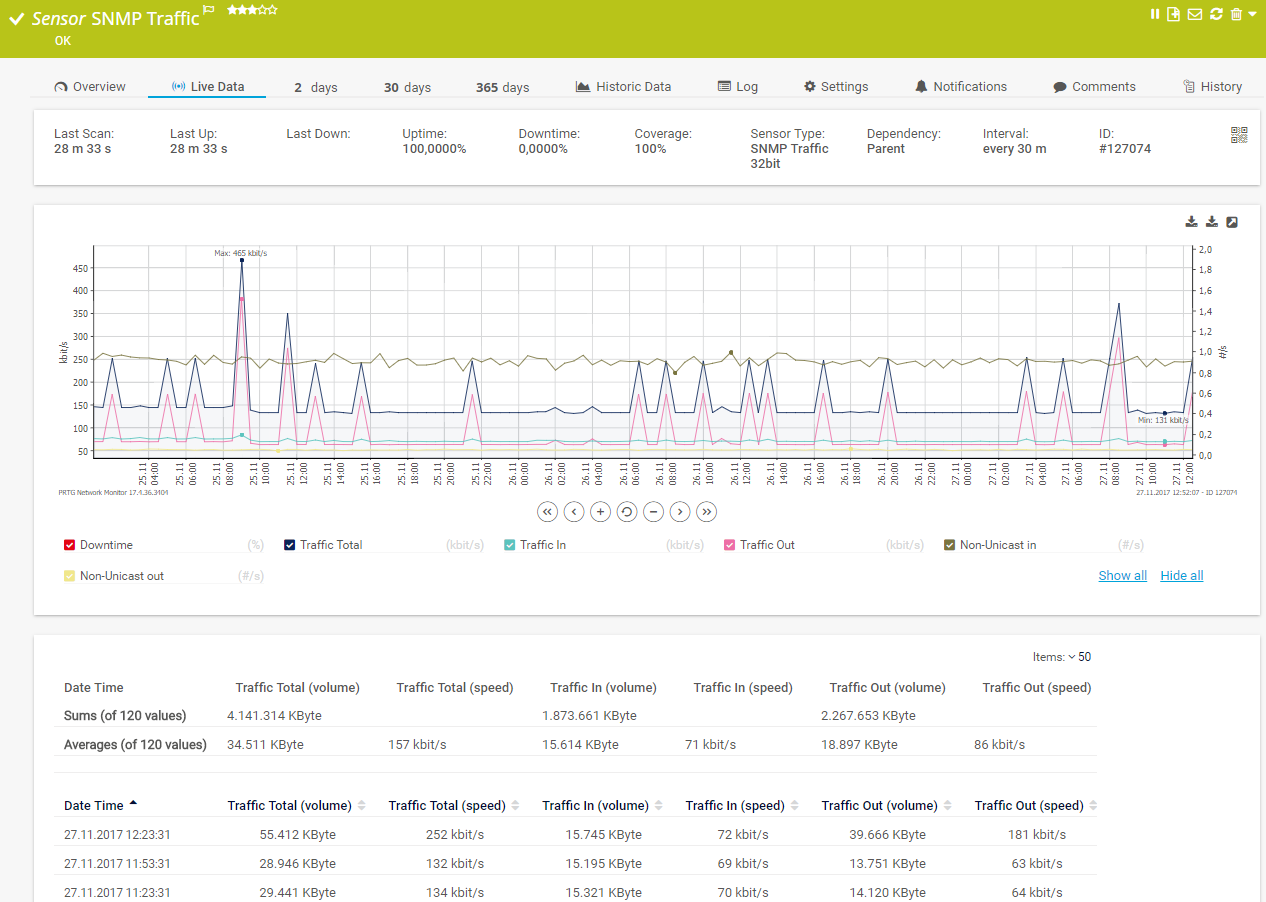
    PRTG screenshot graph live data traffic

    Live traffic data graph in PRTG

    Start monitoring jitter values with PRTG and see how it can make your network more reliable and your job easier.

    Free download
    PRODUCT OVERVIEW

    IT experts agree: Paessler PRTG is a great solution for IT infrastructure monitoring

    PCMag

    “All-around winning
     network monitor”

    IT Brief

    “The real beauty of PRTG is the endless possibilities it offers”

    ITPro

    “PRTG Network Monitor 
    is very hard to beat”

    Run more effective jitter tests with PRTG

    icon click

    Run free jitter tests

    PRTG comes with 100 free sensors that never expire, so you can run free network jitter tests.

    Start by creating a preconfigured jitter monitoring sensor. You don’t have to run a trial first and you can read the jitter value directly from your network.

    icon thumb up

    Run better jitter tests

    Only PRTG’s continuous and automated jitter monitoring including its easy-to read graphs and clear dashboards can determine what is causing your jitter values to fluctuate.

    Other individual jitter tests won't tell you much because they only check jitter for a specific point in time.

    icon adapt

    Measure jitter accurately

    PRTG  complies with the standards of the RTCP for measuring jitter (RFC 1889). Jitter is measured in milliseconds (ms) and displayed directly in the PRTG sensor.

    Methods for measuring jitter include mean packet delay variation and mean absolute packet delay variation.

    Explore our preconfigured PRTG sensors for jitter monitoring

    PRTG comes with more than 250 native sensor types for monitoring your entire on-premises, cloud, and hybrid cloud environment out of the box. Check out some examples below!

    Ping Jitter

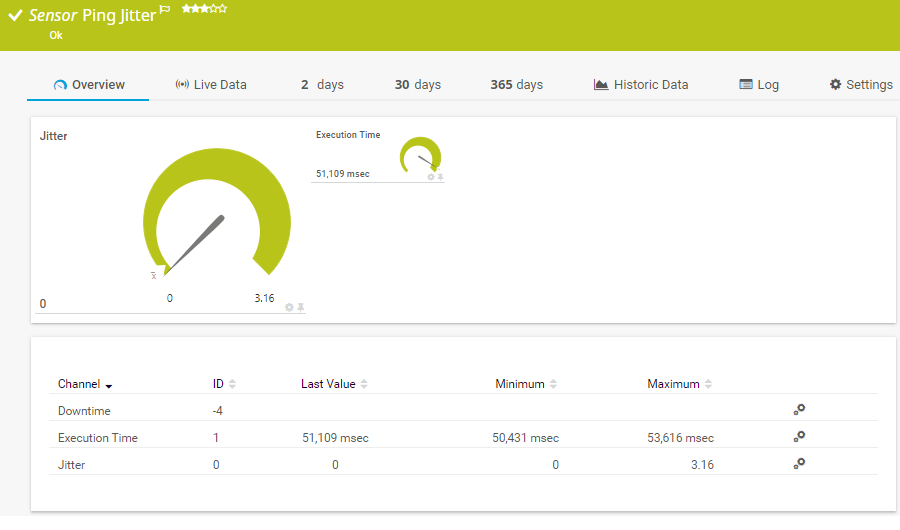
    The Ping Jitter sensor sends a series of Internet Control Message Protocol (ICMP) echo requests ("pings") to a URI to determine the statistical jitter. It can show the following:

    • Execution time
    • Statistical jitter value
    Ping Jitter
    Ping Jitter

    QoS (Quality of Service) One Way

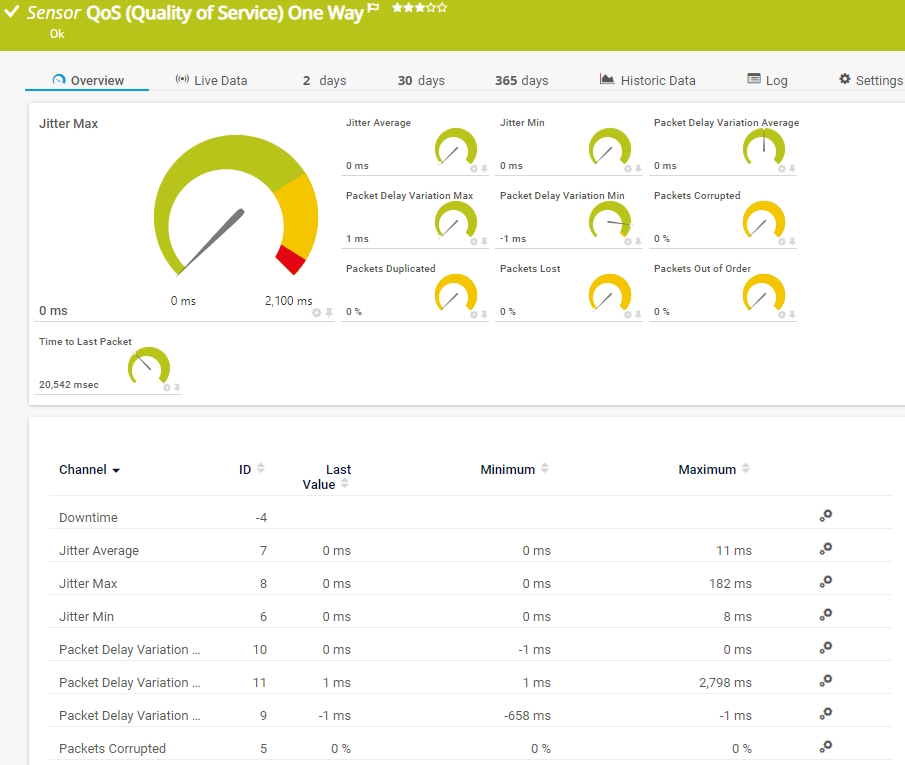
    The QoS (Quality of Service) One Way sensor monitors parameters regarding the quality of a network connection between two probes. It can show the following:

    • Average, minimum, and maximum jitter
    • Average, minimum, and maximum packet delay variation
    • Corrupted, duplicated, lost, and out-of-sequence packets
    • Time to the last packet
    (Quality of Service) One Way
    (Quality of Service) One Way

    QoS (Quality of Service) Round Trip

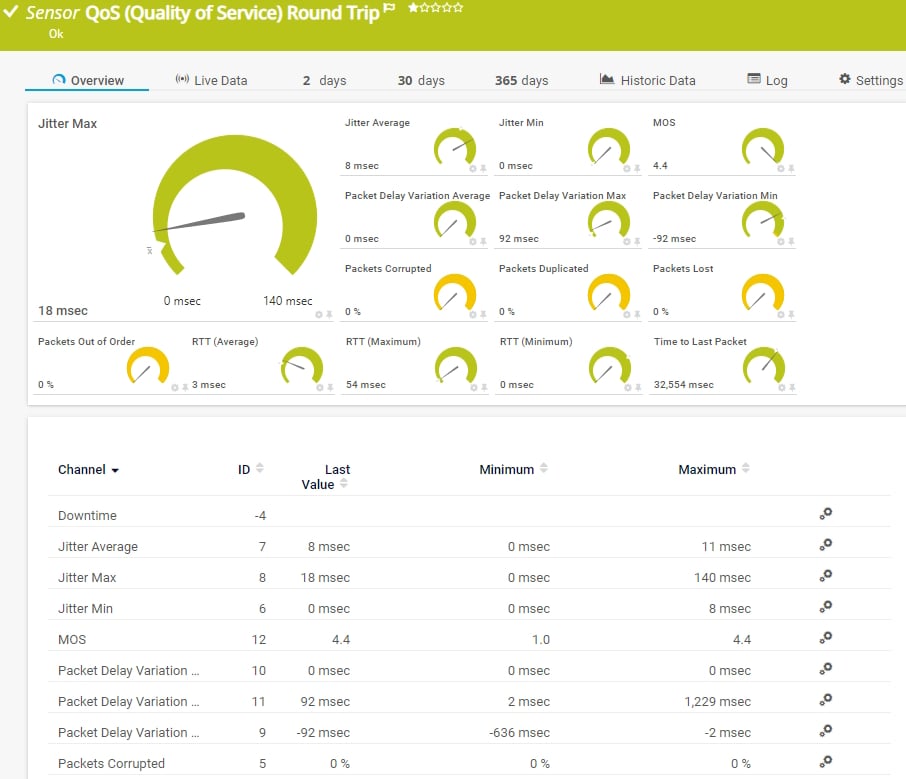
    The QoS (Quality of Service) Round Trip sensor monitors parameters regarding the quality of a network connection between two probes. It can show the following:

    • Average, minimum, and maximum jitter
    • Average, minimum, and maximum packet delay variation
    • Average, minimum, and maximum round trip time (RTT)
    • Corrupted, duplicated, lost, and out-of-sequence packets
    • The MOS
    (Quality of Service) Round Trip
    (Quality of Service) Round Trip

    Cisco IP SLA

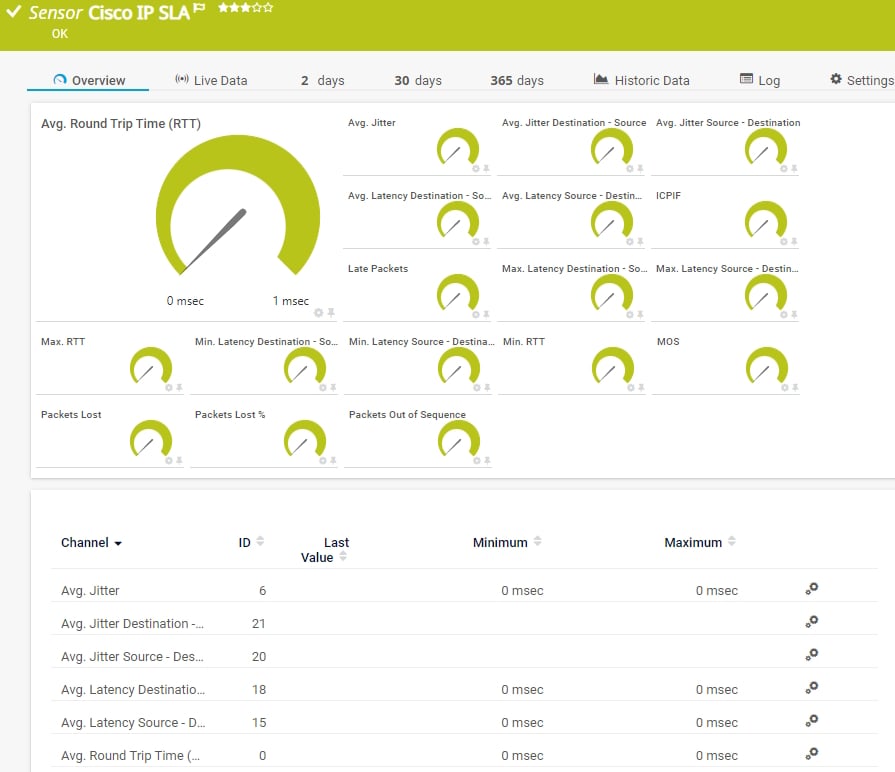
    The Cisco IP SLA sensor monitors Voice over IP (VoIP) network parameters using IP service level agreements (SLA) from Cisco. It can show the following:

    • Average jitter
    • Average, minimum, and maximum latency and RTT (round-trip time)
    • The ICPIF
    • The MOS
    • Number of lost, out-of-sequence, and late packets
    Cisco IP SLA
    Cisco IP SLA

    See the PRTG Manual for a list of all available sensor types.

    Find the root cause of the problem with our PRTG jitter monitoring solution

    Real-time notifications mean faster troubleshooting so that you can act before more serious issues occur.

    Free download
    PRODUCT OVERVIEW

    PRTG Is Compatible With All Major Vendors, Products, and Systems

    compatible with all major vendors, products, and systems

    Optimize your quality of service with these expert tips

    icon one

    Monitor latency

    How much time does a data packet need for its "trip” from the sender to the receiver? This time is referred to as latency. According to ITU-T, the agency responsible for telecommunications standards, latencies of up to 125 milliseconds are acceptable.

    PRTG’s recommendation: Set a threshold of 100 milliseconds. You’ll immediately receive an alert if this value is exceeded, allowing you to act quickly before noticeable interruptions or crashes arise.

    icon two

    Calculate MOS

    The mean opinion score is used to express the quality of a call. VoIP transmission. It is the arithmetical average of several parameters. The lowest MOS is 1, while the highest MOS is 5.

    This score is based on jitter, latency, and other parameters. As a compilation of values, MOS offers a quick overview of the status of your VoIP.

    icon three

    Monitor jitter

    Jitter measures the variation in a mean latency value. We recommend that this deviation be less than 20 to 25 milliseconds, even if this amount is somewhat lower than what is usually considered acceptable.

    What’s important is that you become aware of jitter as quickly as possible so you can take action at once. It also depends on your expectations: for some, jitter and delays of any kind are unacceptable.

    icon four

    Monitor packets

    Individual packets are often responsible for problems with VoIP. Packets can get lost, become corrupted, or arrive as duplicates or in the wrong order.

    PRTG jitter monitoring lets you identify each of these scenarios. We recommend setting your packet loss rate threshold at 0% so that just one lost packet will generate an error message or lead to a malfunction.

    PRTG makes network jitter monitoring as easy as it gets

    Custom alerts and data visualization let you quickly identify and prevent network latency and other network performance issues.

    Free download
    PRODUCT OVERVIEW

    “PRTG helps us to keep control of our IT by making issues visible immediately – and everywhere. We always have an eye on the performance and availability of our IT and can react in time if any failures occur. On a long-term perspective, the monitoring data helps us with capacity planning so that we can deliver the required resources for our own systems as well as for our customers, without wasting money on unwarranted redundancies.”

    Stein Erik Høybakk, Senior Network Engineer
    TAFJORD

    “All our production and business processes depend on SAP. But, of course, IT and production systems also play a crucial role in securing these processes. By incorporating SAP, production, and IT into one centralized monitoring system, we can quickly detect critical drops in performance and identify the causes of these issues. In fact, thanks to PRTG and itesys, this couldn’t be any easier.”

    Andreas Schmidt, Senior Systems Engineer
    Truma

    “Any downtime could be detrimental to our customers. We also strive to provide the best possible service to our customers. PRTG allows us to see the health and performance of the network. Using these measurements we can make decisions on how to repair a piece of equipment before it fails and causes a service interruption.”

    James Ott Jr., Communications System Technician and IT Administrator
    Federal Radio

    Your jitter monitor at a glance – even on the go

    Set up PRTG in minutes and use it on almost any mobile device.
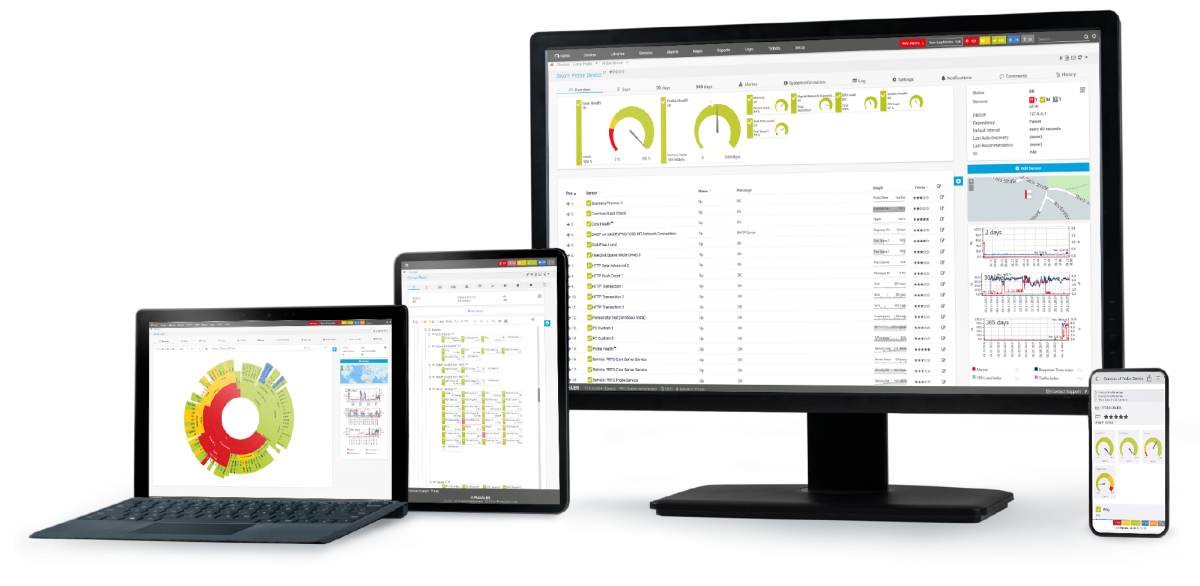
    device overview
    Gartner peer insights

    “Excellent tool for detailed monitoring. Alarms and notifications work greatly. Equipment addition is straight forward and server initial setup is very easy. ...feel safe to purchase it if you intend to monitor a large networking landscape.”

    Read the complete review at Gartner Peer Insights

    Create innovative solutions with Paessler’s IT partners

    Partnering with innovative IT vendors, Paessler unleashes synergies to create
    new and additional benefits for joined customers.

    NetBrain

    NetBrain

    Integrating monitoring results from PRTG into NetBrain maps makes the foundation for network automation.

    Read more
    Plixer

    Plixer

    Paessler and Plixer provide a complete solution adding flow and metadata analysis to a powerful network monitoring tool.

    Read more
    UVnetworks

    UVnetworks

    UVexplorer integrates tightly with PRTG to bring fast and accurate network discovery, detailed device inventory, and automatic network mapping to the PRTG platform.

    Read more

    Find the root cause of the problem with our PRTG jitter monitoring solution

    Real-time notifications mean faster troubleshooting so that you can act before more serious issues occur.

    Free download
    PRODUCT OVERVIEW
    Paessler PRTG

    Paessler PRTG

    Network Monitoring Software – Version 26.1.116.1532 (February 9th, 2026)

    Hosting icon

    Hosting

    Download for Windows and cloud-based version PRTG Hosted Monitor available

    Languages icon

    Languages

    English, German, Spanish, French, Portuguese, Dutch, Russian, Japanese, and Simplified Chinese

    test

    Monitor everything

    Network devices, bandwidth, servers, applications, virtual environments, remote systems, IoT, and more

    test

    Pricing

    Choose the PRTG Network Monitor subscription that's best for you

    Discover more monitoring insights and stories

    Content illustration

    Powerful stories from the monitoring world

    • Why SD-WAN Monitoring Matters - Optimize Latency, Jitter, and ...
    • What Causes Network Jitter and How to Fix It - Paessler Blog
    • All about IT, Monitoring, and PRTG
    Support illustration

    Resources to master your monitoring challenges

    • PRTG Manual: Ping Jitter Sensor - Paessler
    • IP SLA icmp-jitter test not recognised
    • What the difference between packet delay variation and jitter
    Solution illustration

    Solutions for all your monitoring needs

    • Network Jitter Test
    • Monitoring Performance
    • Ping Latency Monitoring

    Jitter Monitoring: FAQ


    What is jitter?

    Data packets are transmitted at a certain speed. A sender sends packets to a receiver in millisecond intervals. Jitter occurs when this interval gets off track, leading to deviations or irregularities in runtime. The term "jitter” means fluctuation, oscillation, or a variation in frequency.

    How is jitter calculated?

    Jitter is calculated mathematically and in a standardized fashion. The IETF has outlined its jitter calculation method in RFC 3550. PRTG uses this protocol to calculate jitter.

    • The Real Time Jitter value is updated every time a packet is received using the formula described in RFC 1889: Jitter = Jitter + ( abs( ElapsedTime – OldElapsedTime ) – Jitter ) / 16
    • The Statistical Jitter value is calculated according to the first x packets received using the statistical variance formula: Jitter Statistical = SquareRootOf( SumOf( ( ElapsedTime[i] – Average) ^ 2 ) / ( ReceivedPacketCount – 1 ) )
    What happens if jitter is too high?

    If data packets reach a receiver at irregular intervals, then loopholes emerge. As a result, data can no longer be circulated on a continual basis. While this may not be a big deal for web or email applications, it can cause interruptions in phone and video calls for companies who use VoIP. You’re also likely to encounter glitches at home when running real-time applications such as videos or computer games.

    What causes jitter?

    One example of how jitter can spike is when a data line is heavily strained, causing bandwidth bottlenecks to appear in intermediate devices. In such a case, your available bandwidth is usually not sufficient (make a bandwidth test). High jitter can also be caused by data congestion in switches and routers. PRTG jitter monitoring promptly alerts you if your hardware is overloaded, so you can intervene quickly – before your system malfunctions.

    How do I eliminate jitter?

    If jitter is high, then you may want to increase your bandwidth. Usually, however, this comes at an additional charge. As an alternative, you can give higher priority to VoIP than to other data packets, such as emails.

    Why is jitter monitoring important for VoIP?

    If a problem occurs with VoIP (Voice over Internet Protocol) during the transmission of data packets, then this protocol is in danger of malfunctioning. One single delayed data packet can lead to transmission errors and delays that are noticeable at once. Jitter can cause the audio signal to go down or fill the line with static.

    How does continuous jitter monitoring differ from one-time jitter tests?

    Continuous jitter monitoring provides ongoing surveillance of network performance variations, unlike one-time jitter tests that only capture a snapshot at a specific moment. Professional monitoring solutions like PRTG automatically track jitter values 24/7, enabling administrators to identify patterns, trends, and intermittent issues that single tests might miss. 

    This comprehensive approach to jitter monitoring ensures that network quality problems are detected early, before they impact critical applications like VoIP or video conferencing.

    What is a sensor in PRTG?

    In PRTG, “sensors” are the basic monitoring elements. One sensor usually monitors one measured value in your network, for example the traffic of a switch port, the CPU load of a server, or the free space on a disk drive. On average, you need about 5-10 sensors per device or one sensor per switch port.

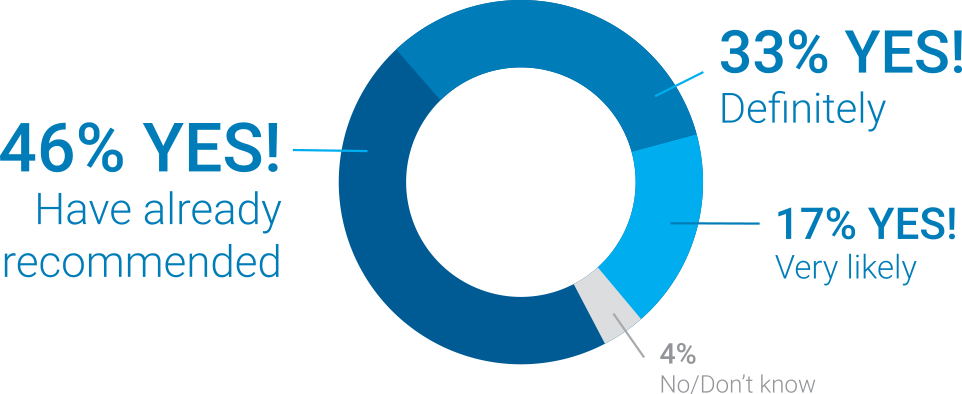
    We asked: would you recommend PRTG? Over 95% of our customers say yes!

    Paessler conducted trials in over 600 IT departments worldwide to tune its network monitoring software closer to the needs of sysadmins. The result of the survey: over 95% of the participants would recommend PRTG – or already have.
    recommendation

    Still not convinced?

    Love

    More than 500,000 sysadmins love PRTG

    Paessler PRTG is used by companies of all sizes. Sysadmins love PRTG because it makes their job a whole lot easier.

    PRTG

    Monitor your entire IT infrastructure

    Bandwidth, servers, virtual environments, websites, VoIP services – PRTG keeps an eye on your entire network.

    test

    Try Paessler PRTG for free

    Everyone has different monitoring needs. That’s why we let you try PRTG for free.

    PRTG Logo

    Start monitoring jitter with PRTG and see how it can make your network more reliable and your job easier.

    Free download
    PRODUCT OVERVIEW

    Products

    • Paessler PRTG
      Paessler PRTGMonitor your whole IT infrastructure
      • PRTG Network Monitor
      • PRTG Enterprise Monitor
      • PRTG Hosted Monitor
      • PRTG UVexplorer
      • PRTG extensions
        Extensions for Paessler PRTGExtend your monitoring to a new level
    • Icon Features
      FeaturesExplore all monitoring features

    Monitoring with PRTG

    • Network monitoring
    • Bandwidth monitoring
    • SNMP monitoring
    • Network mapping
    • Wi-Fi monitoring
    • Server monitoring
    • Network traffic analyzer
    • NetFlow monitoring
    • Syslog server

    Useful Links

    • PRTG Manual
    • Knowledge Base
    • Customer Success Stories
    • About Paessler
    • Subscribe to newsletter
    • PRTG Support
    • PRTG Consulting
    • PRTG Feedback & Roadmap

    Contact

    Paessler GmbH
    Thurn-und-Taxis-Str. 14, 
    90411 Nuremberg 
    Germany

    [email protected]

    +49 911 93775-0

    • Contact us
    ©2026 Paessler GmbHTerms & ConditionsPrivacy PolicyImprintReport VulnerabilityDownload & InstallSitemap
    Finance Finance Finance