
- English
- Deutsch
- Español
- Français
- Italiano
- Português
Cisco infrastructure spans a lot of ground: routers, switches, firewalls, access points, UCS servers, WAN links, VPN tunnels. Keeping visibility across all of it in a multi-site environment means tracking hardware health, bandwidth usage, VPN connectivity, and QoS performance at the same time. Most teams manage this across several tools, which works until something breaks and you need a fast answer.
PRTG uses SNMP, NetFlow, and dedicated Cisco sensors to pull that data into one dashboard. Auto-discovery handles device mapping without manual configuration, and historical trend data sits alongside real-time metrics so troubleshooting doesn't mean correlating exports from three different places. Supported Cisco technologies include Catalyst switches, Nexus switches, ASA firewalls, UCS servers, routers, access points, ACI, WAN modules, and IP SLA probes.

Getting a complete bandwidth picture across every Cisco switch and router used to mean hours of CLI work. PRTG collects NetFlow data (v5, v9, IPFIX) from your Cisco routers and switches and gives you Top Talkers, Top Connections, and Top Protocols without logging into devices one by one. SNMP interface sensors run alongside that, tracking per-port utilization, interface errors, and packet loss continuously.
Hardware health data gives you the lead time to act on your schedule rather than react to an outage. PRTG's SNMP Cisco System Health sensor monitors power supply status, fan RPM, CPU utilization, memory usage, and internal temperatures across Cisco devices. For data center environments, dedicated UCS sensors cover blade health, fabric interconnect status, and chassis conditions. Early warning means replacements happen during maintenance windows, not as emergency responses.
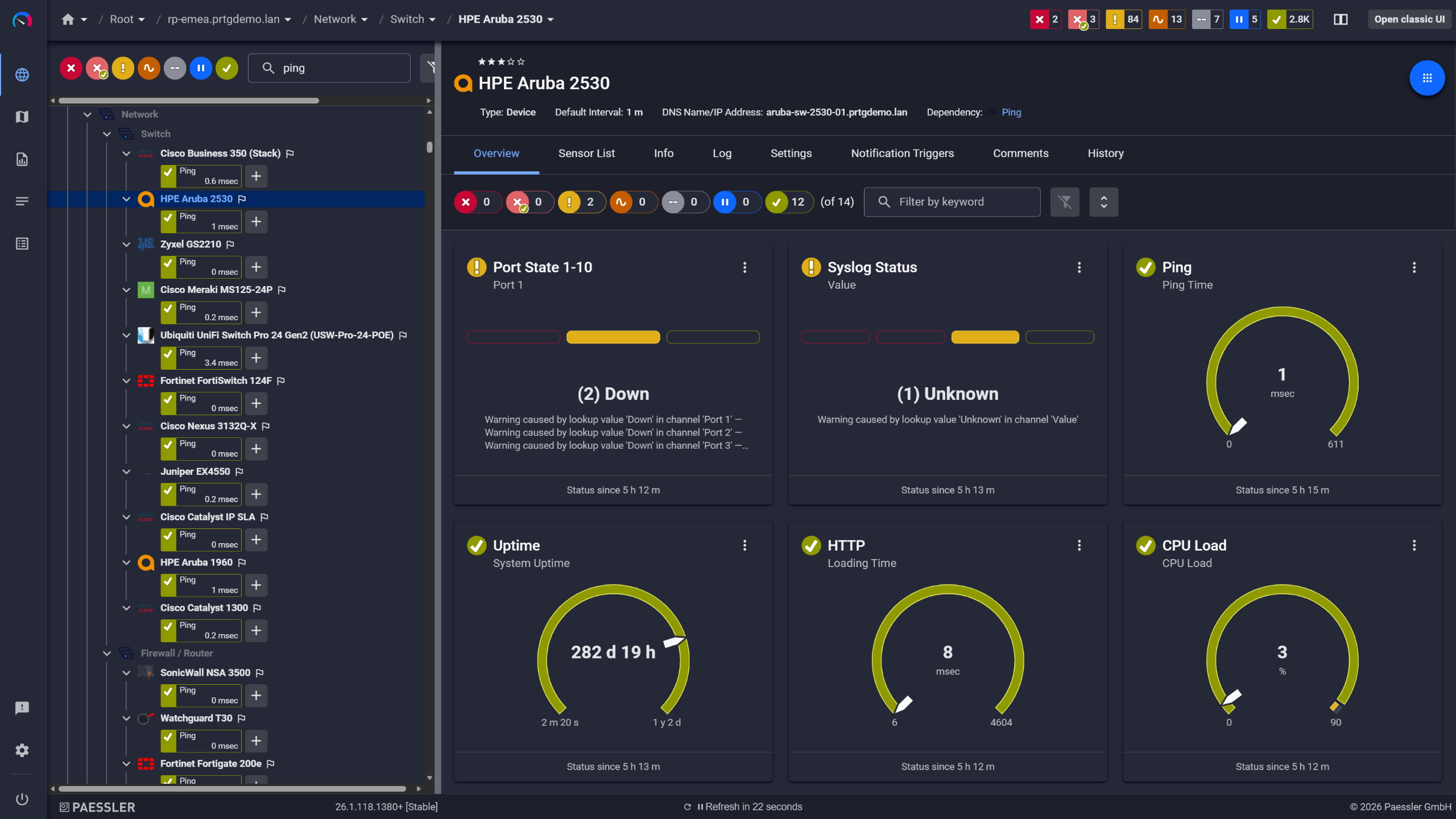
Network switches monitored across vendors
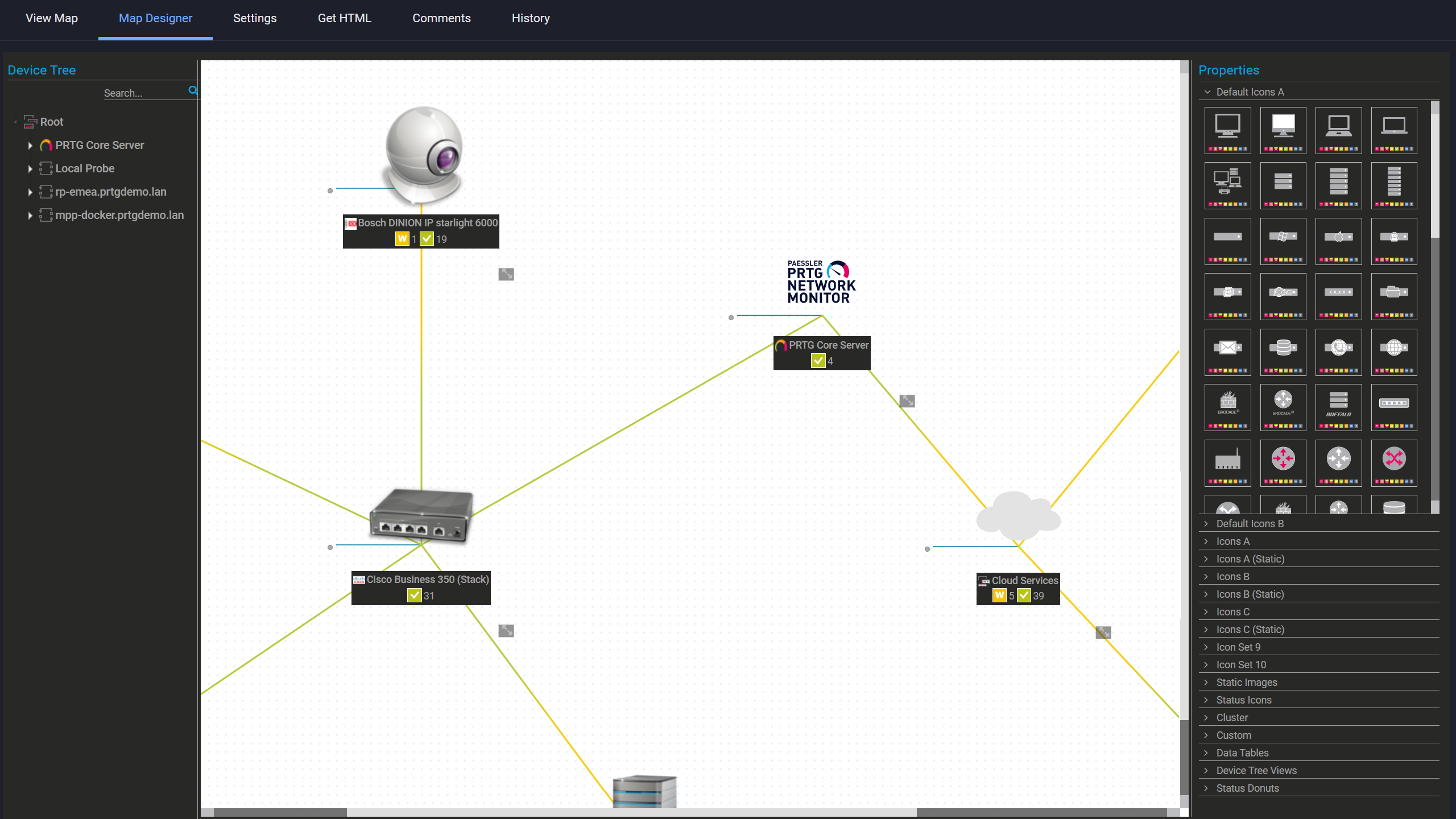
Custom maps with live status
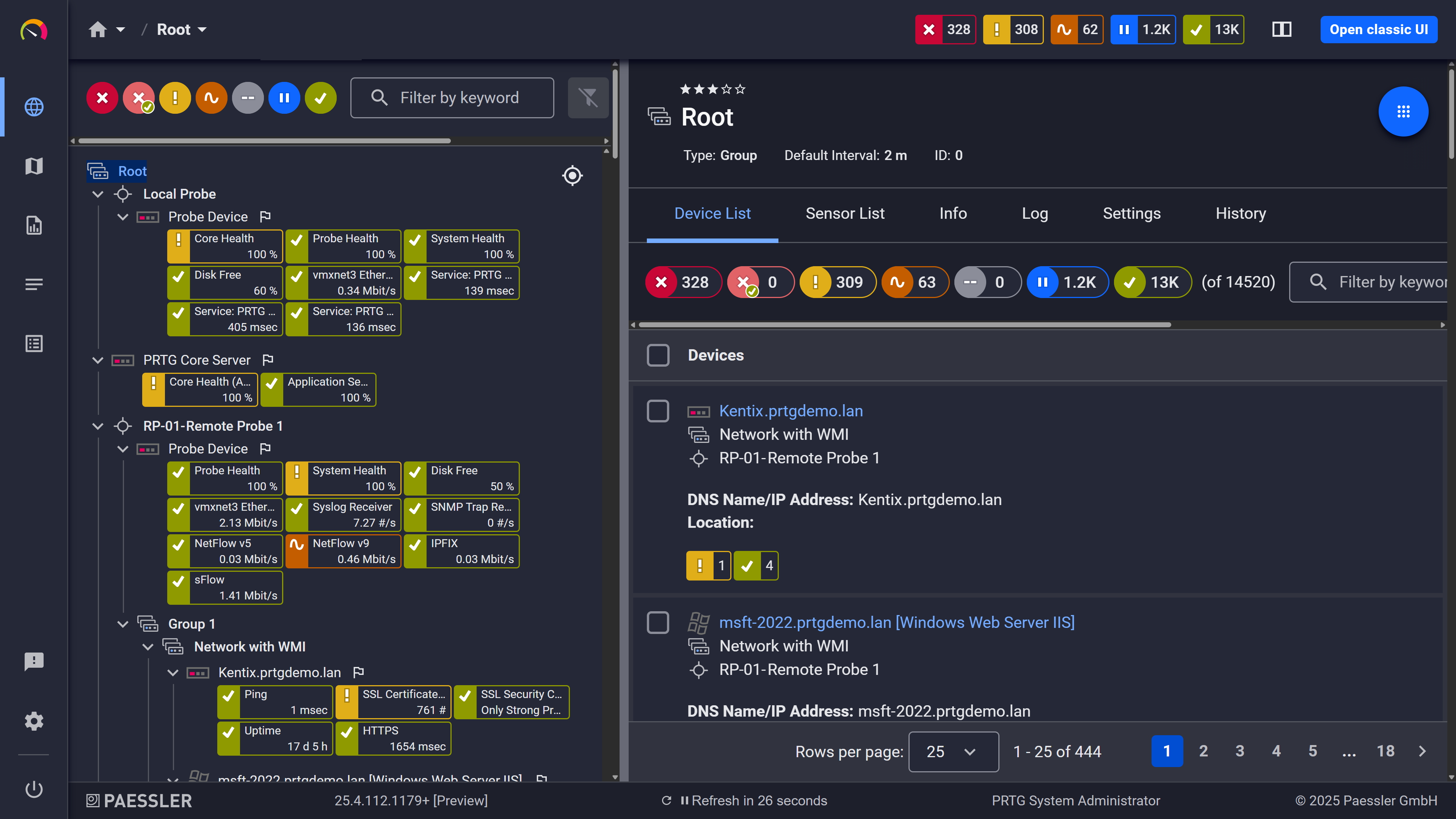
Full device list, instant overview
Site-to-site tunnels drop intermittently. Remote workers report ASA connectivity issues. You have no visibility into how many active sessions are running or which tunnels are unstable until someone calls the helpdesk.
PRTG includes three dedicated SNMP sensors for Cisco ASA monitoring. SNMP Cisco ASA VPN Traffic Sensor covers bandwidth consumed by tunnels. SNMP Cisco ASA VPN Connections Sensor tracks active site-to-site and remote access sessions, and SNMP Cisco ASA VPN Users Sensor monitors concurrent connections so capacity constraints surface before they become complaints. Worth being clear: PRTG alerts on VPN metrics, it doesn't diagnose root causes. Routing issues, encryption mismatches, ISP problems still need logs and diagnostic tooling.
Start monitoring your infrastructure in minutes. No professional services, no complex configuration, no risk.
QoS policies look correct in configuration. What matters is how they perform under real production load, and that requires continuous measurement. The SNMP Cisco CBQoS sensor monitors queue depth, dropped packets, and traffic shaping metrics so you can see exactly how policies behave when the network is busy. The Cisco IP SLA sensor tracks latency, jitter, packet loss, and MOS for voice quality validation using probes already configured on your routers. One thing to note: PRTG reads metrics from probes you set up. It doesn't create or manage IP SLA tests automatically.
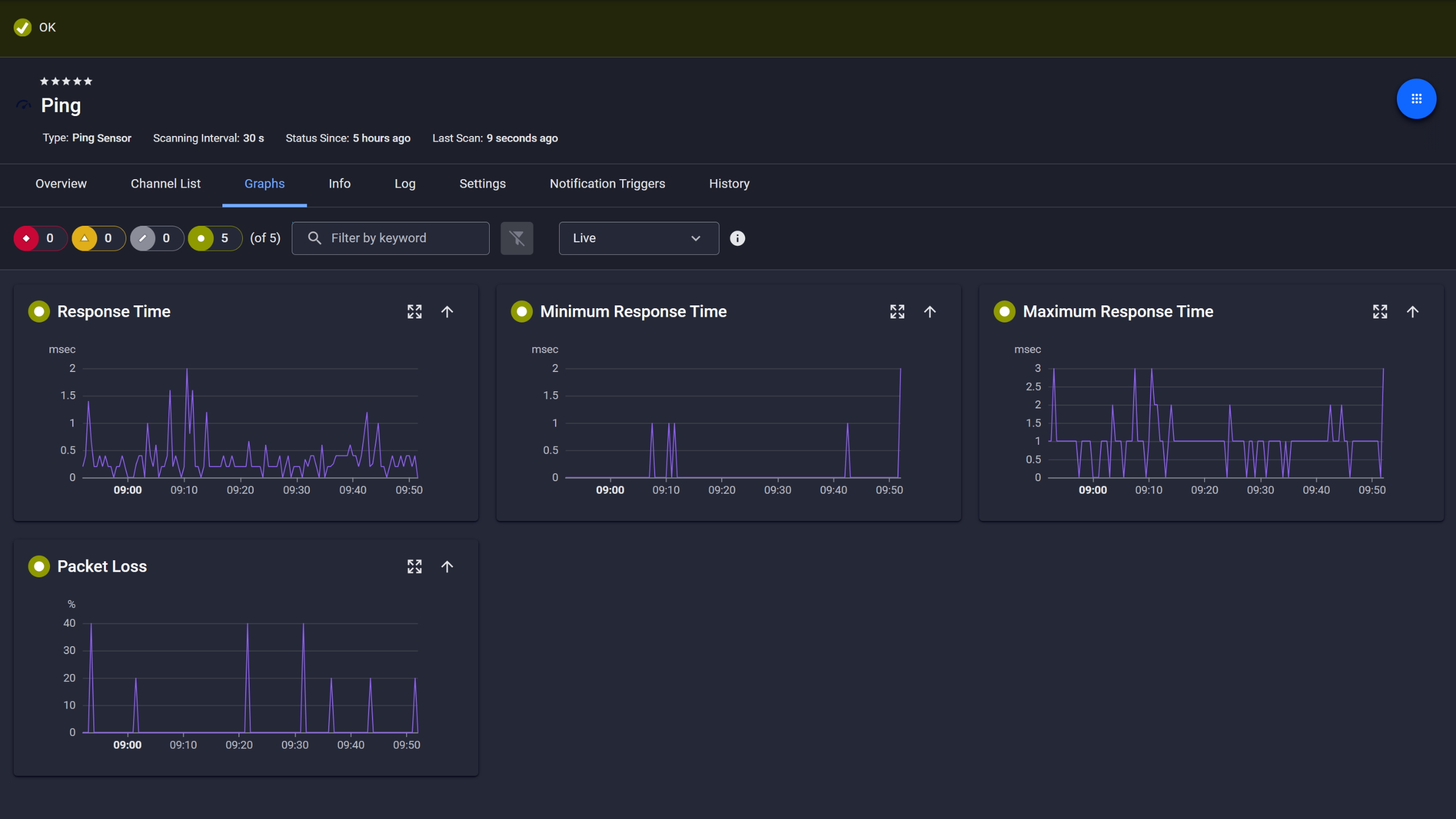
Ping response and packet loss
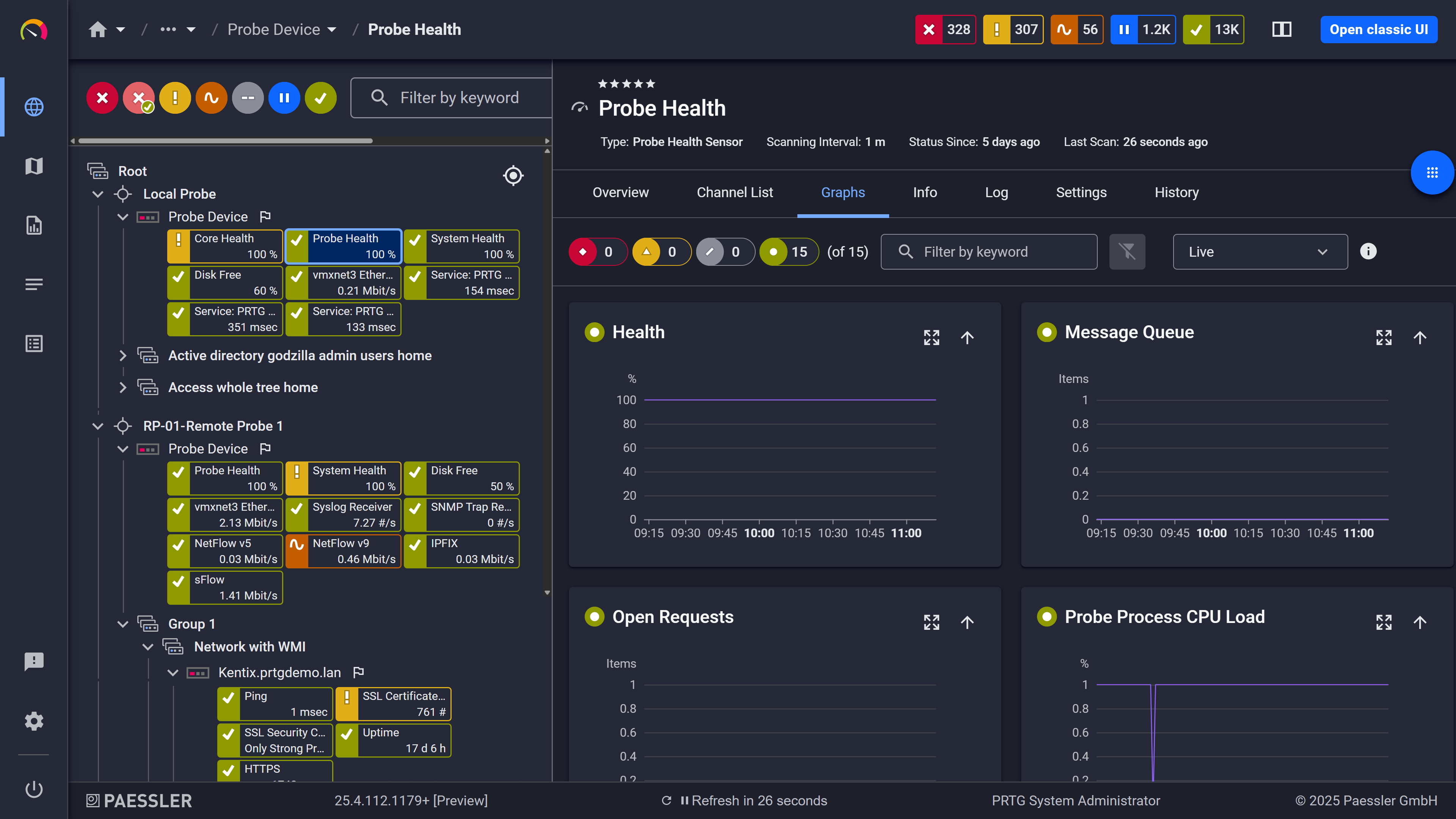
Live graphs, continuous performance data
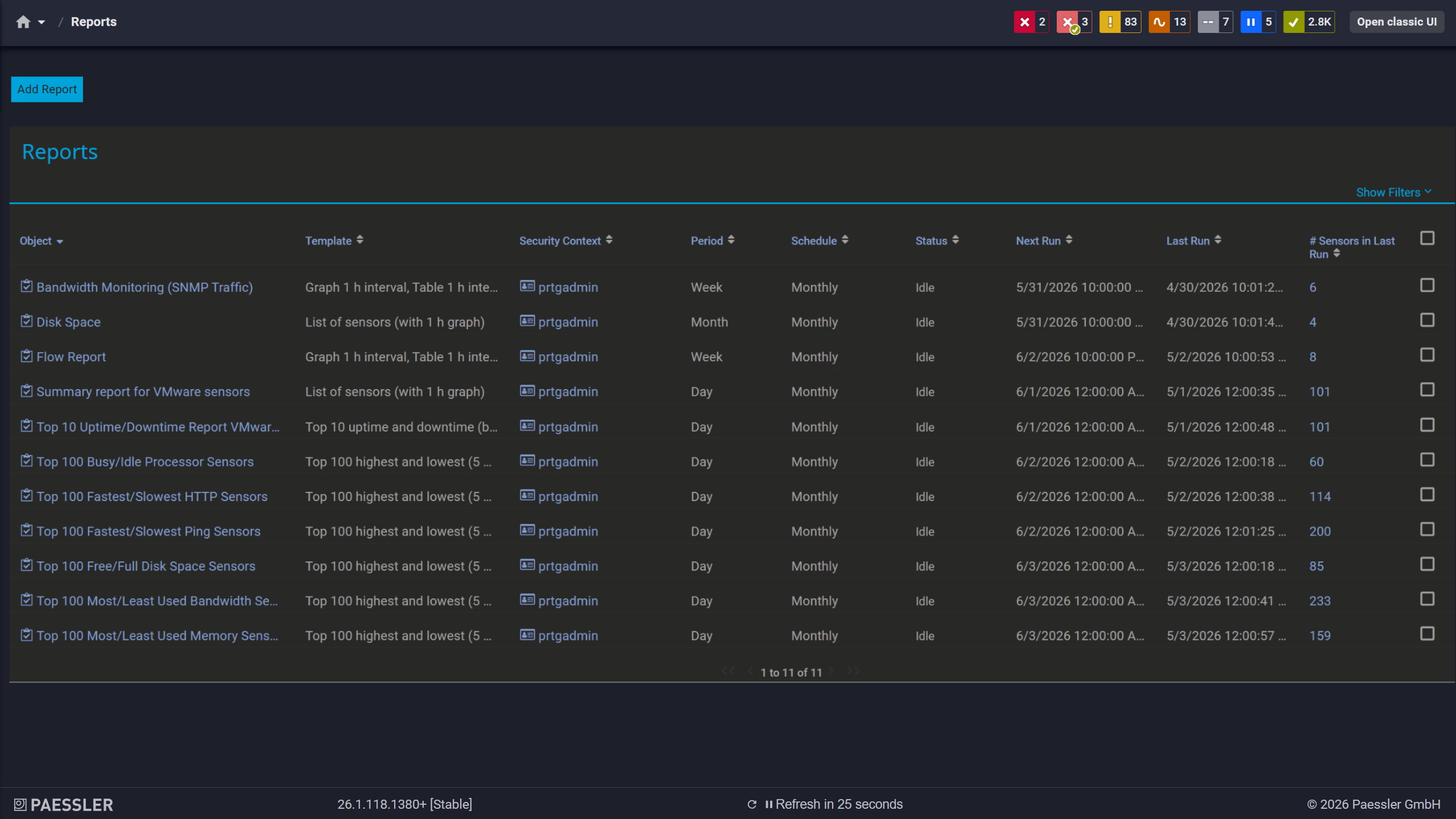
Scheduled reports, always on time
Multiple branch offices, several data centers, cloud locations, and a mix of Cisco and third-party devices: PRTG brings all of it under one roof. Remote probes monitor distributed Cisco networks locally at each site and forward data to the core server. Auto-discovery finds Cisco switches, routers, access points, and firewalls, plus anything else that speaks SNMP or other standard protocols. Centralized dashboards and geo-maps give you a view across the whole environment without switching between tools.
PRTG monitors Cisco network infrastructure using industry-standard protocols and purpose-built sensors. No scripting, no custom development. Routers, switches, firewalls, access points, UCS servers. Network administrators get immediate visibility without building anything from scratch. Five core methods cover the full picture.
Task | Without PRTG Without PRTG | With PRTG With PRTG |
|---|---|---|
Checking bandwidth and port saturation | Without PRTG SSH or Telnet into each device, run show interface commands, export and analyze data manually | With PRTG NetFlow sensors identify Top Talkers, Top Connections, and Top Protocols automatically. SNMP sensors track per-port utilization continuously |
Tracking hardware health (PSU, fans, temperature) | Without PRTG Poll each device via CLI, track status in spreadsheets or tickets | With PRTG Cisco System Health sensor monitors all components continuously. Alerts fire the moment something shows early warning signs |
Monitoring VPN tunnels and sessions | Without PRTG Log into each ASA, run show vpn-sessiondb, repeat per firewall | With PRTG Dedicated ASA VPN sensors track traffic, connections, and concurrent users across all firewalls from one place |
Validating QoS and VoIP performance | Without PRTG Manually review CBQoS stats and IP SLA results on each router — time-consuming and easy to miss degradation between checks | With PRTG SNMP CBQoS and IP SLA sensors collect and visualize performance metrics automatically, with threshold alerts when voice quality or policy compliance drops |
Managing multi-site Cisco infrastructure | Without PRTG Separate tools or manual checks per site. No unified view | With PRTG Remote probes monitor all sites locally. Centralized dashboard and notifications cover the whole network |
Choose the PRTG Network Monitor subscription that's best for you.
| License Name | License description | Price | License Details | Get started | Pricing Details | |
|---|---|---|---|---|---|---|
| PRTG 500 | $200 | per month paid annually | Buy nowBuy now | Enough to monitor multiple aspects of 50 devices | ||
| PRTG 1000 | $358 | per month paid annually | Buy nowBuy now | Enough to monitor multiple aspects of 100 devices | ||
| PRTG 2500 | $742 | per month paid annually | Buy nowBuy now | Enough to monitor multiple aspects of 250 devices | ||
| PRTG 5000 | $1,300 | per month paid annually | Buy nowBuy now | Enough to monitor multiple aspects of 500 devices | ||
| PRTG 10000 | $1,642 | per month paid annually | Buy nowBuy now | Enough to monitor multiple aspects of 1000 devices |

Yes, though how much visibility you get depends on how you set it up. SNMP sensors cover fabric health, leaf and spine switches. For deeper integration API-based custom sensors give you more granularity into your ACI environment. Uptime, performance metrics, connectivity. All trackable from the same platform as the rest of your Cisco infrastructure.
Both work. SNMP monitoring covers Nexus data center switches and Catalyst enterprise switches. Run auto-discovery and PRTG identifies the devices, then configures sensors for interface traffic, hardware health, CPU, and memory. Standard deployments don't need manual sensor setup.
It does come withquite a few. System Health, ASA VPN, CBQoS, IP SLA, UCS. Pre-configured, no scripting. Auto-discovery identifies your Cisco network components and applies the right sensors. For anything outside standard Cisco hardware you can build custom sensors, but most environments won't need to.
PRTG has a REST API. Query sensor data, acknowledge alarms, pause sensors, trigger actions programmatically. Ticketing systems, NOC dashboards, automation platforms, custom applications are all workable. How deep the integration goes is usually a question of what the other system supports, not on PRTG's end.
Partial support. Map functionality covers geo-maps for multi-site deployments and custom dashboards with live sensor status. Layer 2 and Layer 3 topology maps are not generated automatically though, those you build manually in the map editor. Worth knowing before you go in, rather than expecting automatic topology discovery.
Scales well for both. Remote probes handle distributed sites, clustering covers high availability and thousands of devices across routers, switches, firewalls, and WAN links are monitored. Licensing is flexible enough that it doesn't become a bottleneck. Service providers and enterprise networks run PRTG at scale regularly.
Yes. Cisco wireless access points and controllers via SNMP. Signal strength, connected clients, bandwidth usage, connectivity. Sits in the same platform as your wired Cisco monitoring. Same dashboards, same alerts. No separate tools.
Network Monitoring Software – Version 26.1.116.1532 (February 9th, 2026)
Download for Windows and cloud-based version PRTG Hosted Monitor available
English, German, Spanish, French, Portuguese, Dutch, Russian, Japanese, and Simplified Chinese
Network devices, bandwidth, servers, applications, virtual environments, remote systems, IoT, and more
Choose the PRTG Network Monitor subscription that's best for you